Discover the ancient history of Cornwall’s Treryn Dinas, and the idiot from the British Navy who toppled Logan Rock.
When people visit this part of Cornwall, they’re usually off to the stunning Minack Theatre to watch a play or heading to Porthcurno beach for a sunbathe and swim. Many, too, are heading to Pedn Vounder due to an influx of online articles and viral social media posts proclaiming it is the most beautiful beach in the UK. I’d agree, but only on the infrequent days when it’s not overrun by influencers searching for content. Going by the ant trail of people carrying everything but the kitchen sink down the precarious path, it seems the National Trust’s “Footpath Closed” sign and steel ropes blocking said path have deterred nobody. Why should safety get in the way of good social media content?! (If you were in any doubt, that last sentence was sarcasm.)
However, most people are missing the best part of this stretch of coastline: Treryn Dinas.
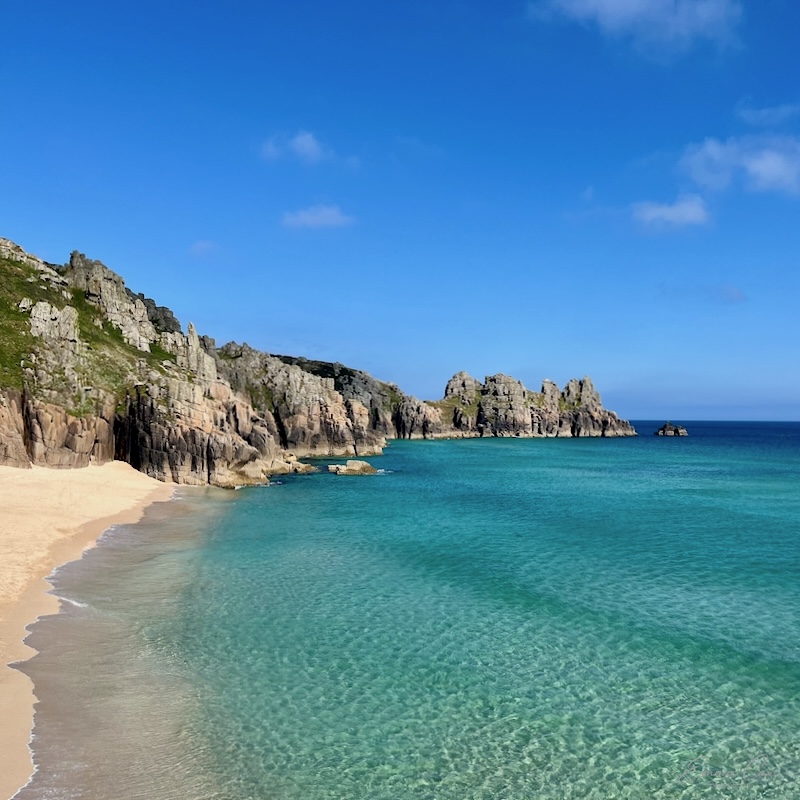
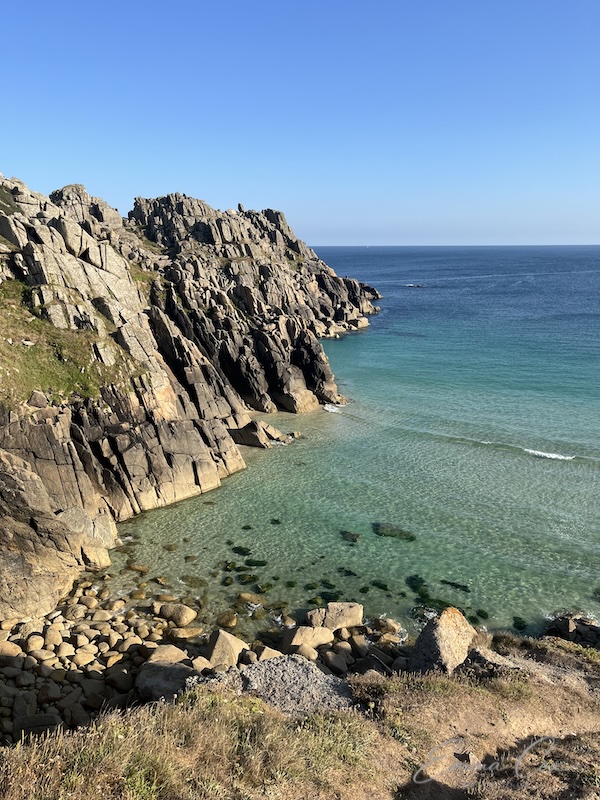
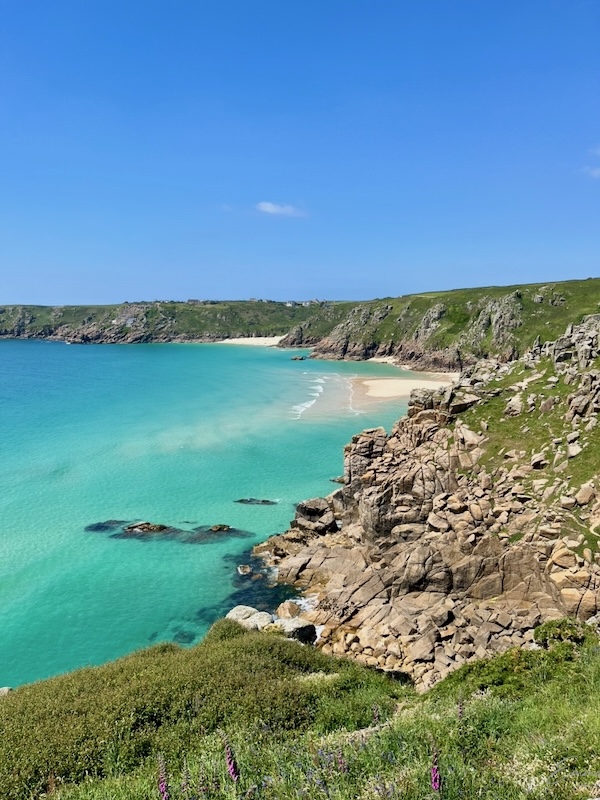
Treryn Dinas (Treen Castle) is the headland of time-worn granite which acts as a backdrop for all the above. Huge stones balance precariously on top of one another. Others rise like weathered cathedral spires. Human-like profiles make the viewer question if the whole folklore about the giants who lived here might actually be true.
The Iron Age Fortress
Don’t get me wrong, I love a good beach. But I find myself drawn to headlands. A narrow point surrounded on three sides by the wild Atlantic. Perhaps it’s an ancestral feeling of sanctuary because more often than not I discover a Bronze Age or Iron Age fortress was situated there. With the sea and cliffs on three sides for protection, and only a skinny neck of land to defend, Treryn Dinas is no different. Here stands the worn remnants of an Iron Age promontory fort. With such perfect natural defences in the perilous granite, no sane person is going to try and capture it by sea (who knows, maybe they did). Its sole weak point was from the mainland. Here, the defensive earthworks are still highly visible. Today, I can simply walk through them, but back then, I’d have had to navigate three separate ramparts with ditches. Nobody was getting in here uninvited.
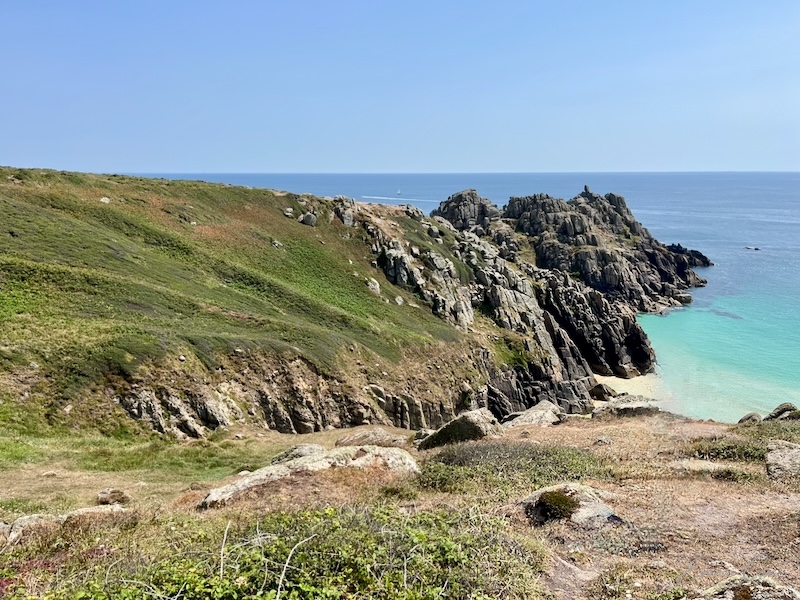
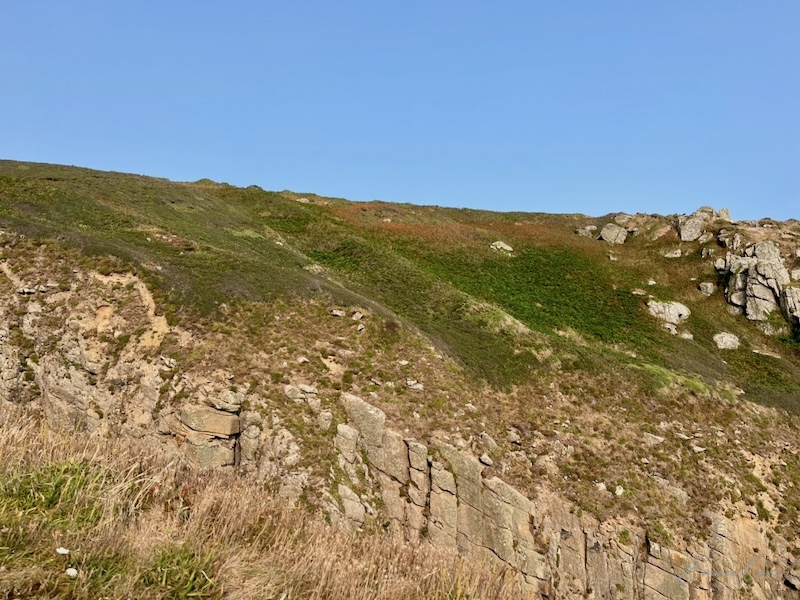
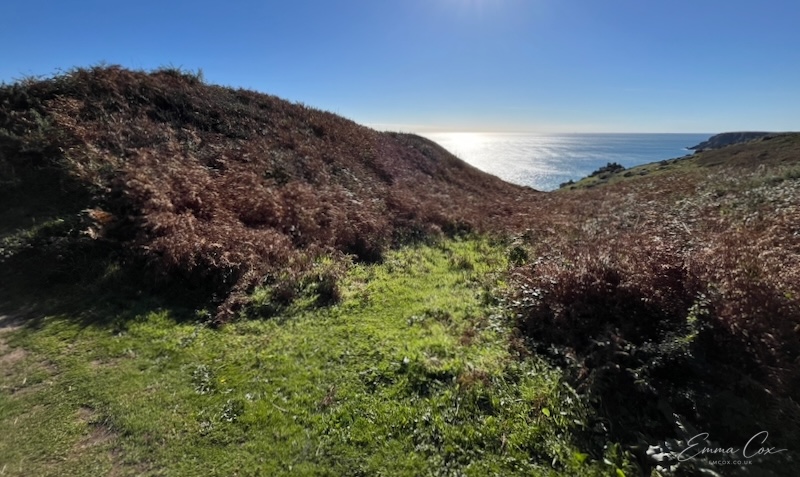
Although the embankments are Iron Age, Treryn Dinas is a site which beguiles humans to continue visiting. Besides the Iron Age ramparts and two round houses, Bronze Age cremation remains have been found amongst the impressive granite, and Roman finds show it continued to remain in use after the Iron Age. Two square structural remains postdate the ramparts and have been marked as ‘watch houses’, although no date is given. A watch house is a probable suggestion considering there is a WWII pillbox near Porthcurno and up the county, near Gorran Haven, there is a Napoleonic watch house still standing at Dodman’s Point. As an island nation, there has never been a time when we stopped watching our shores.
Logan Rock and the Bloody Stupid Bloke from the British Navy
Most people visit Treryn Dinas because of its famous Logan Rock. Logan is pronounced “log on”. Log probably comes from the Cornish dialect meaning “to rock” or it’s possibly a Cornish expression used to describe the swaying movements of a drunkard. Both meanings work as a logan stone is a naturally large stone which is so finely balanced it can be rocked by a finger.
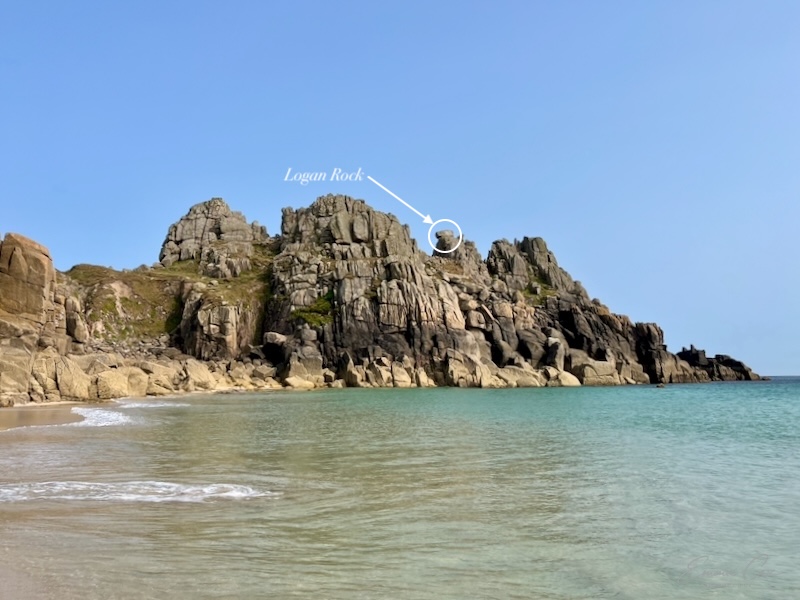
Past the Iron Age embankments you reach the headland proper and, if you don’t mind a bit of rock climbing, can reach the near-80 tonne Logan Rock and give it a poke. Unfortunately, it doesn’t rock quite so well as it once did. This is the fault of the British Navy; specifically, the fault of a rather dickish Lieutenant Hugh Goldsmith, and fourteen of his crew from HMS Nimble, who wanted to prove a point.
Cornish antiquarian, geologist and naturalist William Borlase (1696-1772) wrote a lot about Cornwall. Indeed, he wrote it was physically impossible to topple Logan Rock.
…it is morally impossible that any lever, or indeed force, however applied in a mechanical way, can remove it from its present situation.
W. Borlase, Antiquities of Cornwall
Really? thought Goldsmith. Surely such a feat would be possible by the British Navy! So, in April 1824, using ropes, capstans, bars and wedges, Goldsmith and his crew rocked Logan Rock until it topped three feet and wedged itself in the cliff.
As you can expect, that didn’t go down well. Think of the recent outcry when the Sycamore Gap tree was cut down. Nobody in Cornwall was happy to learn of his random act of vandalism of such an iconic site.
Plus, Goldsmith wasn’t doing this on his time off. He and his crew were employed to stop smugglers. It was by luck that a smuggled cargo of 64 barrels of booze was discovered, seized and taken to Penzance Custom House at the same time Goldsmith and his lackeys were pissing about, trying to prove how manly they were.

Forced by public opinion, Sir Vyvyan, the landowner, insisted an attempt to restore Logan Rock should be made, and Goldsmith should be the one to do it. The Admiralty were induced to make a loan of machinery from Devonport Dockyard and grant £25 pounds towards the work (£2500 in today’s money), with a further £150 subscribed (£14,600). Machinery was utilised from the local area, including that which was used to re-erect Lanyon Quoit, which blew over in a great storm in 1815. As per usual, the event brought the crowds to watch the stone being put in place. ‘Thank God, it moves!’ are Goldsmith’s supposed words when Logan Rock was first hoisted from the spot at which it’d toppled. Luckily, the names and accounts remain of those who worked on resetting the stone. John and George Berryman got 3s per shift on night watch duties. 58 men were paid a total of £5 16s 0d for a day’s labour lifting Logan Rock. However, the funniest entry is the one which states: Mr William Charnhalls for 60 St Just men who did nothing but drink beer to the value of 13s 6d.
Once work was complete, Goldsmith was rewarded with a slap-up meal for a job well done. I don’t think he really deserved that considering Goldsmith’s restoration was a botched job. Logan Rock did not sit quite as well as it once did, and had to be secured by chains and props to stop future idiots from toppling it. In fact, Goldsmith felt no remorse in his brash act of vandalism, as in 1825, he renamed is boat Logan Stone. He died of yellow fever at sea in the West Indies in 1841. In his short obituary, he is remembered for being the nephew of Oliver Goldsmith, the famous writer, and for being the dick who dislodged Logan Rock.
The locals, unhappy to see their beloved stone toppled and then badly restored, went to make improvements. Records of this are sketchy, but it appears that in 1842, James Tregartha and John Hutchens, from the nearby Treen, devised an ingenious invention of four screws which tweaked the alignment until Logan Rock once again rocked freely and securely.
However, something of Logan Rock’s magic died after Goldsmith toppled the stone. As one letter writer to the Royal Cornwall Gazette states:
What power could restore to it the mystic influence which invested it before? “Where is that Promethean heat that can thy former light relume,” which it derived from the day of ancient Druidism, and which still continued, in spite of reason and physics and geology, to fill the imagination of every beholder with the visions of poetry and romance?
Royal Cornwall Gazette – November 1824
The letter writer has a point. Although we know the stone is simply a natural occurrence, it still holds that mystical quality. Albeit, the magic of nature rather than some ancient Druidical power. When a man brazenly goes and destroys it just because he can, it severs our connection to nature.
However, Treryn Dinas did not fully lose its magical qualities. It is a place thick with folklore, from Merlin, witches, fairies, and giants. But those tales will be for a later article.
Notes
- Royal Cornwall Gazette – April 1824
- Royal Cornwall Gazette – November 1824
- St Austell Gazette and Cornwall News – May 1944
- Cornishman – July 1930