Discover the folklore surrounding Cornwall’s Treryn Dinas, including giants with serious marriage problems, ghost ships, and a wrecking witch.
Following on from the history of Treryn Dinas, the dramatic granite headland near the village of Treen in West Penwith, I now turn to its folklore.
The key to the castle
Casting aside logic and geology, it is said Treryn Dinas rose from the sea by enchantment. No one knows the name of the magician who did this. However, the famous Merlin gave his opinion back when he was swanning around Cornwall. There was said to be a rock with a hole in it. Within the hole was another stone which could be moved but not pulled out. Merlin prophesied that if this “key” stone were to be removed, the spells would be broken and Treryn Dinas would fall back into the sea. About the same time Lieutenant Goldsmith was vandalising Logan Rock, it is said further vandals (possibly Goldsmith himself – I wouldn’t put it past him) chipped away the rock and cast the key stone off the cliff. Fortunately, the headland didn’t disappear back into the sea. If bad luck fell upon the unknown men who removed it, then that is a tale lost to time.
Dan Dynas, the big friendly giant
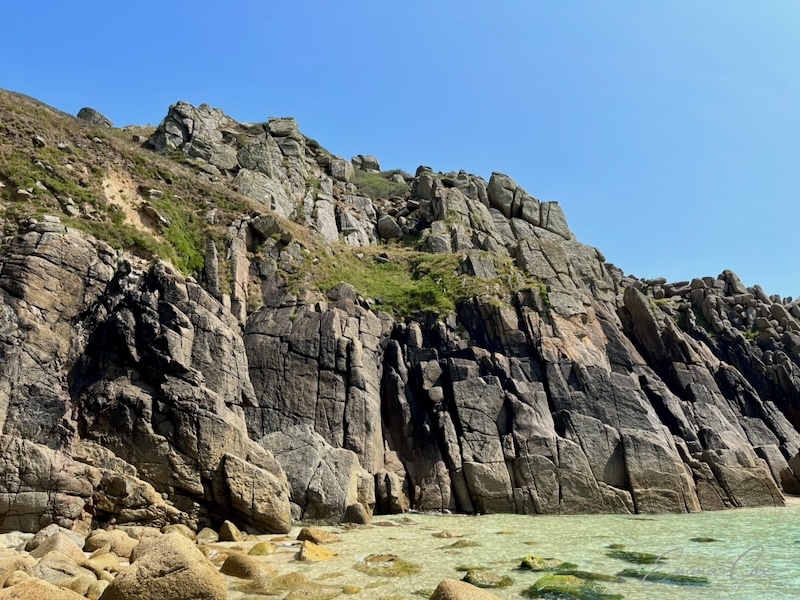
Giants feature heavily in Cornish folklore, so it comes as no surprise that a few crop up at Treryn Dinas. Dan Dynas was a deaf and mute giant who lived with his giantess wife, An’ Venna. They were a benevolent couple, taking pride in defending their land and its inhabitants. It wasn’t our Iron Age ancestors who built the ramparts and dug the ditches of the promontory fort on the headland, but the work of Dan Dynas and An’ Venna to keep the people’s tin and cattle safe from marauding pirates. An’ Venna put herself and the womenfolk to task on collecting stones so they had a plentiful supply of ammunition. Whenever they were besieged, An’ Venna and the women would hurl stones at the pirates while Dan Dynas led the men to do battle and drive the enemy away. It is also said Dan Dynas would stand on the cliffs at nearby Porthcurno and hurl giant rocks using a bull hide as a sling at any invading ships. Many of these great stone piles, made by the giantess and the women, remained long after but have since been looted and incorporated into local houses and boundary walls.
Dan was a gentle giant, but one who didn’t quite understand his strength in comparison to a human’s frail body. He delighted in games, and the children often came to play quoits with him. But they did tend to come home with broken ribs, much to the distress of their parents (and Dan Dynas’).
The Giants of Castle Treen
Human lives inevitably come with a fair bit of drama. The same goes for the daily lives of giants. In this folkloric soap opera, we meet another husband and wife couple living in Treryn Dinas. William Bottrell’s account is sympathetic to the giant husband, but I will try to keep the tale balanced.
Like Dan Dynas and An’ Venna, the married giant and giantess protected the local inhabitants from invaders. I am clueless about the lifespan of giants, but when the local people discovered the couple were getting on a bit and with no sign of thunderous rumbles of little giant feet, they worried about a future without the giants to help defend their homes.
Luckily, nobody was presently invading, and the idle giant grew increasingly fat and lazy. The giantess often found him dozing in his granite chair on the headland. He seemed content with this easy living, while she pined for a child and grew increasingly peevish at her feckless husband.
With their marriage on the rocks, the giantess took the initiative. As no one was invading, she suggested he take some exercise by rocking Logan Rock to regain a bit of muscle or swim out to sea to catch fish for supper. Sometimes, the giant took his wife’s advice. Sometimes he rocked the stone, but more often, he cheated by lounging in his granite chair and effortlessly rocking the stone by poking it with a long staff. Inevitably, he fell asleep, only to be rudely awakened by his irritated wife with a well-aimed shower of pebbles. The years fell away, and the rock cradle remained empty.
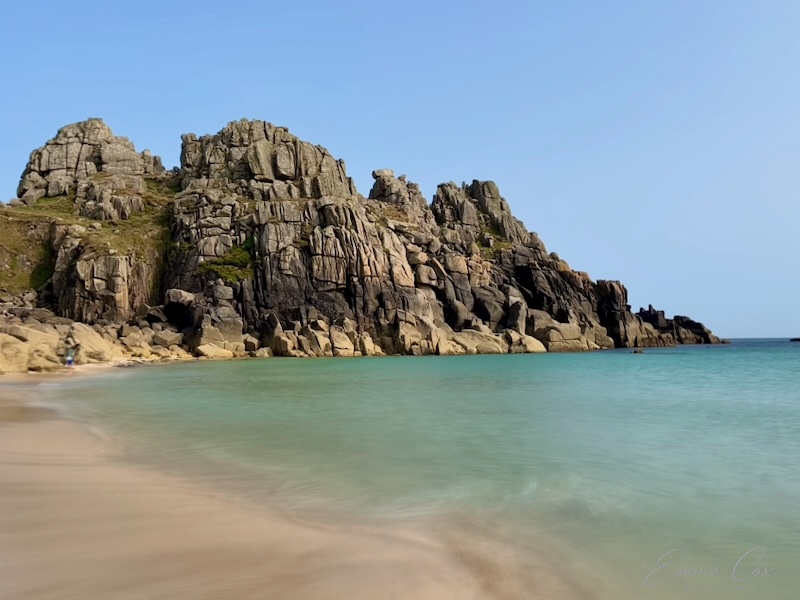
The people of Treen came to the giants with an idea. One of their witches, who could shape-shift, would sneak across the border to the neighbouring giants of Maen and steal a baby. They had too many, they reasoned, and the neighbours didn’t much like the other. Lots of granite boulders in the vicinity are said to be the ones either side had hurled at the other during neighbourly disputes.
The giants approved, and the witch led a four-year-old giant back to Treryn Dinas, much to the delight of the giants (and the relief of the residents of Treen).
Time passed. The baby giant grew, and his father would take him to the peak of Treryn Dinas so he might see the length and breadth of the land he would one day rule. The giant taught the boy all he knew, which wasn’t much, while the giantess ensured her adopted son had food aplenty and grew healthy and strong. With her time devoted to her child, her husband was left to get his own meals, and his stout body turned weak and skinny.
When the boy reached adulthood, something changed in the relationship between his adopted mother. The giant would often find the two of them alone, and he soon suspected his wife’s devotion to their adopted son had turned to passion. Despite the child, their marriage had never truly mended, so the giant did not feel a great loss. However, he spent too many years idol and was set in his ways, and the very thought of his routine being disrupted by his wife and foster-son made him angry. So he made a game of disrupting them on their clandestine moments alone. In the hours he went to find provisions for himself, he’d order them to come help him carry his dinner home. One winter’s day, the giant stomped home, grumbling at the weight of the bullock on his back and the two sheep under each arm. No family came to aid him. He knew they would be at Treryn Dinas, all loved up together. But as he came through the ramparts, he found home empty. The giant snarled, swearing vengeance on his ungrateful family. The giantess and foster-son had heard his approach and heard his wrath. In fear, they hid. But the giantess knew a fight was coming, and she would have the first blow.
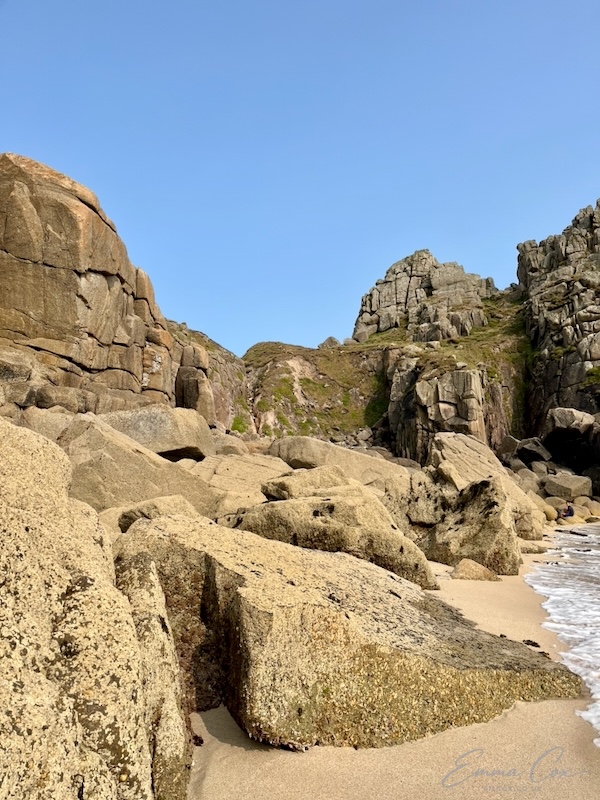
As the giant stomped across the narrow gap on the headland, his wife appeared from her hiding place and struck her husband. He tumbled from the cliffs, dashing his skull on the rocks below. The giantess, realising with horror at what she had done, covered her apron over her head lest she see his broken body or hear his howls of agony.
With his dying breath, he cursed her and she turned instantly to stone. The foster-son, he spared, but what happened to him after is lost to time. The profile of the petrified giantess remains, but she is so old and worn by the centuries of tempests that her features have melted into the granite.
A variation of this tale is told by Robert Hunt. Here, the young giant is not their adopted son, but another who held allegiance to the Treryn Dinas giant. However, he rather fancied the giant’s wife, and made many advances upon her. One day, the young giant stabbed the Treryn Dinas giant while he was dozing in his granite chair and kicked his body into the sea.
The Small People of Pedn Vounder
Today, Pedn Vounder is awash with Influencers in search of content. An ant trail of visitors scramble the precarious (and closed) cliff track to reach the beach. Before the humans found it, it was home to the fairies.
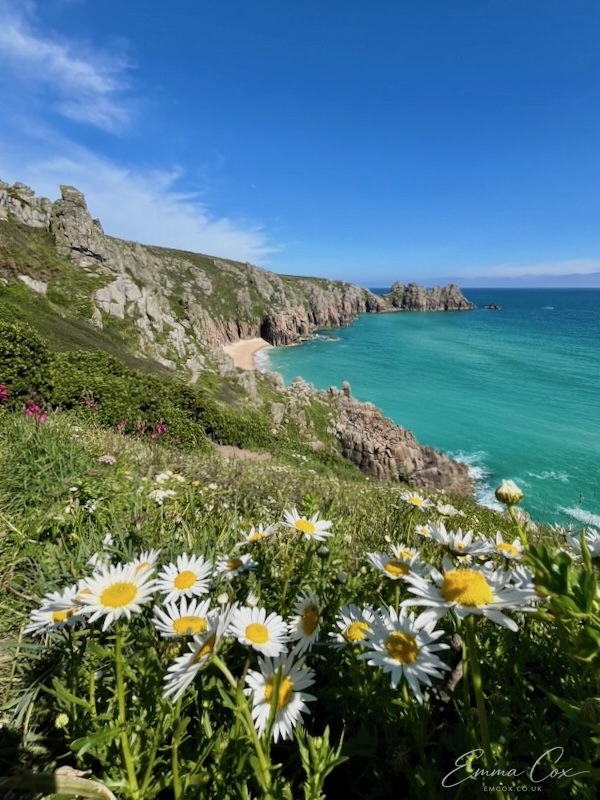
Becalmed fishermen often told tales of the sights they saw on the cliffs above the high-water mark. Thousands of Small People, brightly dressed and acting merrily. Delicious scents and faint fey music would drift across the waters. If the fishermen had oars, they’d row away, lest they be tempted to join them.
St Levan’s Witches
St Levan was said to be a bit of a hot spot for witches, wizards, and the like. This is probably down to the old ways and stories still lingering, along with all the ancient stone sites we continue to romanticise. It’s still true now. When a family member remarked to a vicar I was moving from mid-Cornwall to west-Cornwall, their reply was, ‘What, where all the witches and hippies live?’

Logan Rock was an iconic landmark and was A Place of Power (is your medallion humming? Can you tell I played the Witcher games too much?). “Was” being the important word here. Since Lieutenant Goldsmith vandalised Logan Rock, it has lost its power to cure a sick child if they were rocked upon it. If you climbed to Logan Rock and touched it at midnight on the last day of the year, you would become a witch (if through power or by initiation, it’s unclear). St Levan’s Witches used Treryn Dinas as a meeting point. From there, they would fly away on their stems of ragwort to make mischief. Ragwort isn’t favoured by most farmers as it’s toxic to livestock. However, it is a plant with strong links with the fairies. To us, it is a weed. To them (and witches), it is a mode of transportation.
Old Madge Figgy
Old Madge wasn’t your typical witch. Wander a little further west from Treryn Dinas, and you’ll find Gwinnap Head and the Chair Ladder landmark where she went to call up a wind. Flying conditions needed to be perfect if she and her witchy friends were going to ride their ragwort stems all the way to Wales to steal the milk from the cows there.
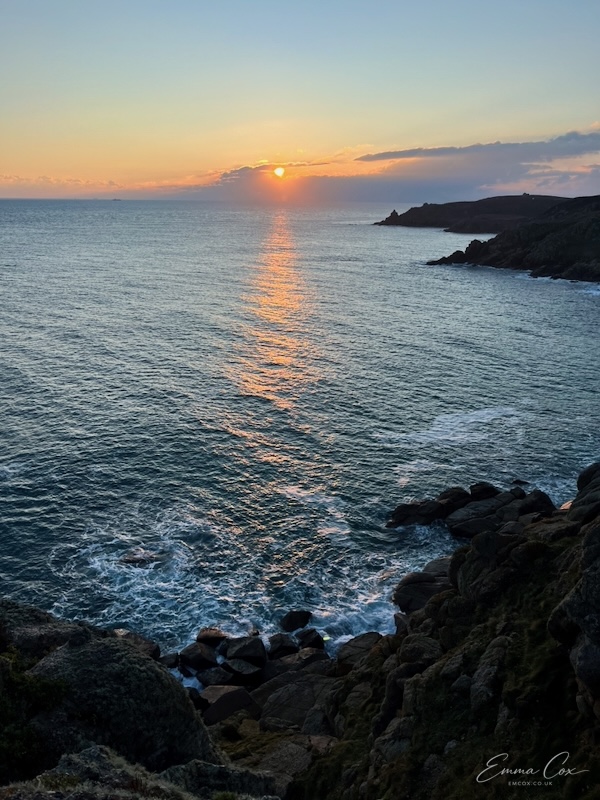
Calling up a storm was another perk of her other career as a wrecker. One night, after calling up a wind which wrecked a ship, she and her wrecking group ventured to the cove; their pockets and sacks were bulging with plunder. Suddenly, Old Madge’s attention went straight to the body of a naked woman, the wreckers having already stripped her of her clothes and jewellery. Old Madge pointed to a mark on the woman’s chest that only she could see. ‘It would be worse for you if they didn’t give up what you took from this body,’ she told the wreckers.
The wreckers, believing Old Madge just wanted a bigger share of the booty, grew angry. Some even threatened to murder her if she kept this up, but Old Madge wasn’t the sort to back down. A few, being rightly wary of the old witch, complied and gave up the jewellery they had seized from the dead woman. Many didn’t. At that moment, a great wave washed into shore, knocking those still holding onto the dead woman’s riches off their feet. Ill luck followed those men until they gave up the gold and jewels to Old Madge, which she kept safely hidden, and waited for a knock at her door.
The man was a Spaniard, and husband to the dead woman wrecked on the beach. ‘It takes one to know one,’ she told the man as he gave him his wife’s possessions, for the invisible mark on the body had been a witch’s curse.
Another tale of Old Madge Figgy highlights her uncanny means of getting a good bargain. Tom had a sow he planned to fatten up for winter. If he wished to sell it, it would easily be worth a £1. Old Madge offered him 5s for it. Naturally, he declined.
‘You’ll regret that,’ Old Madge told him.
Afterwards, the sow ate voraciously, yet it grew leaner and sicklier. Knowing he was out of luck, Tom took the sow to market to try and recoup what money he could. The sow had other plans. Despite barely being able to stand, once it was on the road, it ran like a greyhound and led Tom on a merry trail. Eventually, the sow got itself stuck under a bridge, and nothing Tom did would free the animal.
Then Old Madge turned up.
‘If you can get her out, you can take her,’ said Tom, being in short temper and hungry.
Old Madge called to the sow, who freed itself and followed her home like a dog.
The Ghost Ship of Porthcurno
Ghost ships were a common sight at nearby Porthcurno. It is said there was a navigable channel here which has long been filled in with sand. However, the ghost ships remember their old routes and have been seen passing along those old currents, and following dead rivers up the valley and over land. In olden times, the sign of a ghost ship heralded the imminent attack by living, breathing enemies.
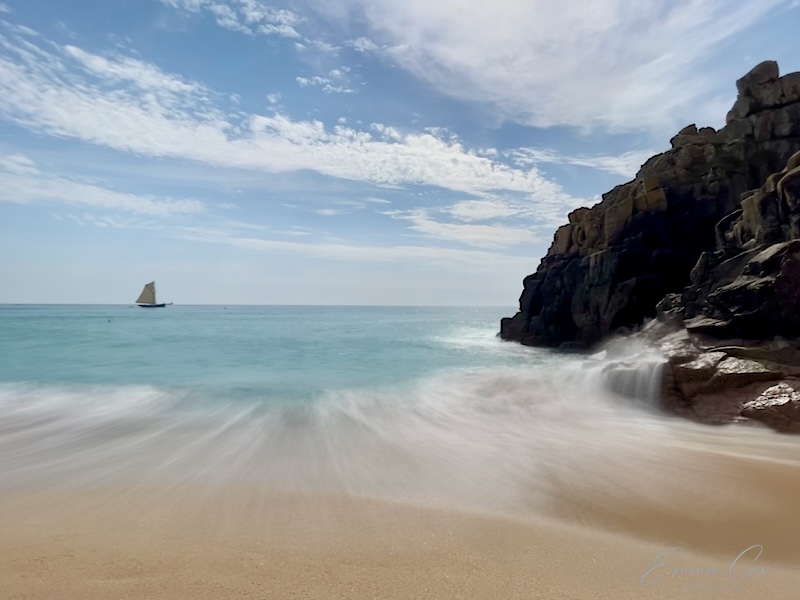
In more recent times, a ghost ship sparked another origin tale. A ship arrived in Porthcurno, captained by a local man thought long dead. He was accompanied by a foreigner who never spoke, save to his captain. They were said to be pirates for the captain threw gold around like chaff. If they weren’t out at sea in all weathers, they took their dogs along the moors, hunting, echoing even older tales of the wild hunt and the devil hunting with his hell hounds. Eventually, the captain died, but not before making his companion swear to bury him at sea. Although a coffin was buried in the churchyard, it only contained soil to weigh it down. The foreigner took a chest containing his captain’s body onto his ship and departed in a week-long storm which choked up Porthcurno so no ship could dock there again. However, the captain’s ghost ship still sails the old route.
Notes
Popular Romances of the West of England – Robert Hunt
Traditions and Hearthside Stories of West Cornwall – William Bottrell