Cornwall’s Celtic identity
Storytelling was born from curious, questioning minds as a means to make sense of our surroundings.
Cornwall’s roots are in its Celtic identity. That identity came from the stories and beliefs of those ancient people. All we have left are the remnants in place names, folklore, and the stone monuments that withstood the test of time.
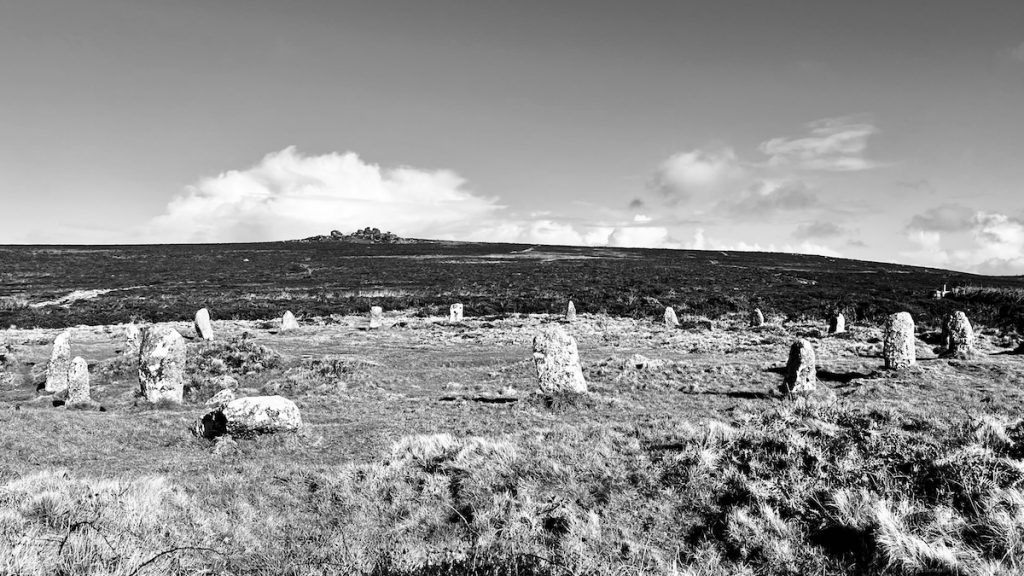
Ancient stones look to the summit.
Encounters with the Fae
Stone circles are popular with fae folklore. It is a place where fairies or piskies might be found. One account tells of a miner who came upon a fairy feast in Tregeseal stone circle. The fairies tied him up in gossamer thread and left him there all night. Another man says he was piskie-led to the same circle where he met the little folk. While piskies are thought to be mischievous in a (mostly) harmless fashion, the same cannot be said for the spriggans. These spirits haunt old ruins and treasure filled barrows and are the sort who’d blight your crops and steal your children.
The Bards and Druids
Boscawen-ûn Stone Circle is thought to have been known for its poetry and storytelling. The Welsh Triads, written in the early medieval period, name it as one of the three principal gorsedds (Bardic meeting places) of the island of Britain.
Our knowledge of the druids is limited to that of the invading Romans, but it didn’t stop people from romanticising and/or demonising these people. Naturally carved bowls in the granite are often associated with druidic human sacrifice. At Menacuddle Well, there is a stone-hewn chair named the Druid Chair, although it’s likely to be only a couple of hundred years old and part of a rich man’s garden. But the story’s invoked by calling it the druid chair sounds much more appealing.
A similar find can be found in the Rocky Valley, where two labyrinths are carved into the rock. They could have been carved as early as the Bronze Age or as recently as the Georgian era. But people are spiritually drawn to the spot as the nearby Hawthorne is awash with clooties.
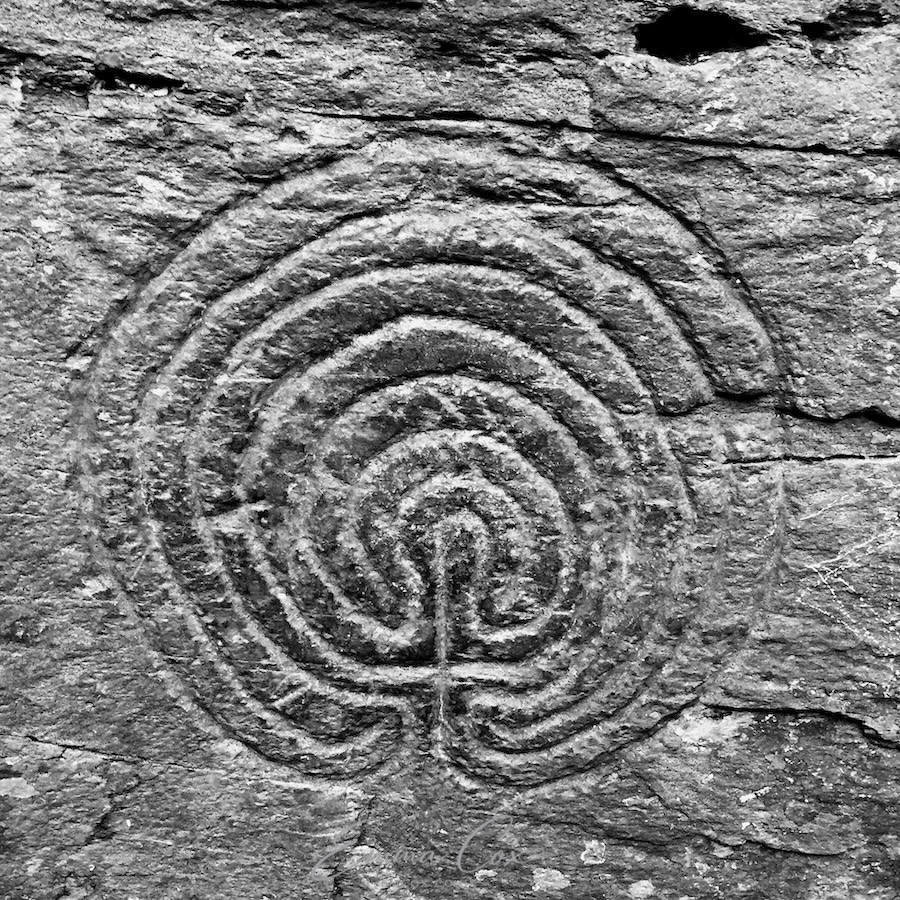
Rocky Valley maze rock carvings.
The Enduring Legend of Arthur
King Arthur is an enduring myth throughout Britain, with many spots in Cornwall claiming an association with the fabled king. Tintagel was said to be his birthplace. The castle remains which stand today are more of a powerful man’s folly. Richard, the Earl of Cornwall, built the castle in the 13th century as a means of connecting with the Arthurian legend. By the 14th century, the rich man’s folly was left to go to ruin. It wasn’t until the revival of the Arthurian legend in the Victorian era that the ruins became a tourist destination. In the cove below is Merlin’s cave. What Merlin did here, I do not know, for it is filled by the tide for half the day.
The similarity in name has led people to speculate that Camelford, by the river Camel, was once Camelot. Nearby Slaughterbridge is said to be named after Arthur’s final battle with Mordred. An inscribed stone nearby is named King Arthur’s Stone, despite the ogham and latin inscription reading, “Latinus, son of Macarus, lies here.”
Cornwall is also the spot for the Lady of the Lake. There is King Arthur’s Hall on Bodmin Moor (actually a late Neolithic enclosure), and lithic monuments such as Lanyon Quoit were repurposed by Arthur as a feasting table.
Saints and Devils
The beliefs of those early ancestors have long gone, but their stone monuments remain, along with Cornwall’s own unique folklore. The missionaries from our Celtic neighbours in Wales and Ireland brought Christianity. Churches and holy wells were built on the bones of old beliefs and sacred places. Standing stones were reworked into crosses or inscribed by those who wished to be remembered. The inscription on King Doniert’s stone asked for prayers for his soul. The Christian presence added another layer to Cornwall’s folktales.
Standing stones were said to be petrified folk punished for enjoying themselves on the sabbath with games, music and dancing. Fairies and the like were renamed as devils. The Tregeseal stone circle with its mischievous fae folk stands beneath Carn Kenidjack, where strange lights are seen, and two miners swore they witnessed a wrestling match there presided by the Devil.
Saints proved God’s divine power by challenging the supernatural folk or by banishing them through the power of prayer. The Cheesewring, on Bodmin Moor, is a natural formation, but the story of its origin explains that it was built by a saint and a giant in a stone tossing competition.
Cornwall’s Giants
Giants are a common folklore in Cornwall. The most popular one is Jack the Giant Killer (the title gives away the story). Cormoran is the sea giant at St Michael’s Mount and has a taste for livestock. Jack, the strong and clever son of a farmer, makes a death pit and kills Cormoran. Blunderbore vows vengeance on his giant kin and captures Jack, taking him to his enchanted castle. But Jack slays Blunderbore and his brother, Rebecks, and (because it’s what heroes do) finds some captive ladies to free. And so Jack starts his giant killing trade.
My favourite giant tale of Wrath’s Cupboard (or Ralph’s Cupboard as the landmark is now known). The roof has now collapsed, but it was once a huge sea cave which housed a giant. He liked to pick up passing ships and eat the crew, save for the really skinny sailors, who he left to drown.
Stories from the Sea
The sea houses many creatures of myth. The mermaid is the most popular, with sightings and stories associated with Zennor and Padstow. But the story which intrigues me more is the bucca. The stories associated with this figure range from the remnants of a long lost sea deity to a type of bogeyman story to scare small children. Bucca’s story has some crossover with the knockers, who inhabit the mines and warn miners of impending rockfalls.
Retellings of the Old Tales
Methodism grew popular among the miners and other working class people. John Wesley would preach to thousands from Gwennap pit. Today, religion has a looser grasp than it once did. But the myths and folklore still endure, along with the churches and stone monuments. Fantasy writers mine these old stories and beliefs. Being Cornish, I feel I can add my own voice to these tales in a way that is sympathetic to their origins. Even if these characters from folklore and myth do not exist, the stories are entertaining.
But saying that, I’m convinced I have been piskie-led on more than one occasion.
Leaving the Liminal Space
The path diverges. If you wish, stay amongst the stones and spriggans, or head back to town and the people. But perhaps the dark opening into the earth is calling you below ground.
Links: