Ancient Trails
Walking is my meditation. Following trails, new and old, from one place to another. The destination doesn’t always matter, but these paths all lead to places.
The Tinner’s Way is a Bronze Age trail from St Just to St Ives and is still walkable today. The Saint’s Way, running from Padstow to Fowey, was likely a Celtic trading route that later became a possible pilgrimage trail as it passes numerous churches, holy wells and shrines. St Michael’s Way passes from Lelant to St Michael’s Mount and is part of a network leading to St James’ Cathedral in Santiago de Compostela in northern Spain.
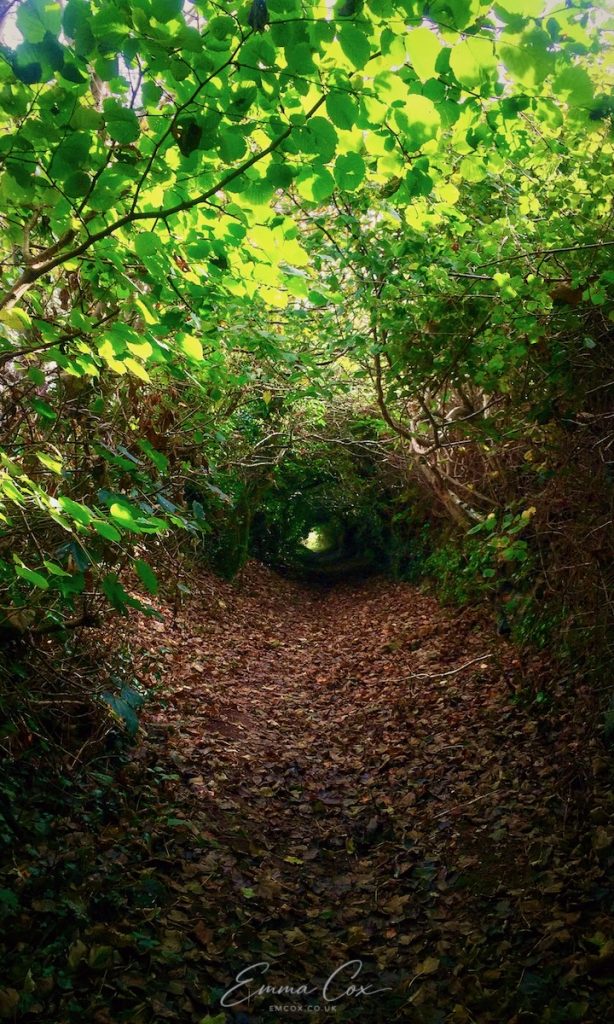
Leading us into shelter.
Invisible Lines
Ley Lines, popularised by investigators and authors such as Alfred Watkins (The Old Straight Track) and Hamish Miller (The Sun and the Serpent), can also be sighted and dowsed through Cornwall. The St Michael line is the most prominent and can be traced to its beginnings in Cornwall, right across the country to Norfolk. These arrow-straight paths align with historical structures and prominent landmarks, guiding travellers across the land.
There are newer trails. Popular paths became roads. Tracks were laid for the railway. Traffic increased, and new roads were carved into the landscape. Public footpaths link settlements and wrap around the entire coastline. People moved from place to place.
Primal Places
Chysauster and Carn Euny are two of the oldest settlements that were occupied from the Iron Age to the late Roman period. The latter includes a fogou, a stone-lined underground passage. Such passages are only found in west Cornwall, and their purpose is up for debate. I find fogou’s to be primal, womb-like spaces. I find myself wondering if there was a ritualistic purpose to these spaces, or if they were practical, used as storage or a hiding place if the village came under attack.
Settlements emerged along these routes. On the coast, in port towns and inland, swelling around castles and manor houses. Bodmin is the only town mentioned in the Domesday Book. Camelford, Launceston and Lostwithiel shortly followed. Truro, despite being Cornwall’s only city, was a much later arrival. Some settlements, like Bude, grew in size and population on the back of the tourism industry.
A Cast of Cornish Characters
These ports, towns and villages all housed many characters. Cornwall is said to be the home of giants, and one that we can be sure did exist is Anthony Payne. Standing at 7’4” and weighing 32 stone, Payne must have been a formidable sight when he fought for the Royalists during the Civil War.
Sir Humphry Davy experimented with nitrous oxide and found he couldn’t stop laughing. Discovering laughing gas is probably not the best thing Davy is known for. A chemist and inventor, he created the Davy lamp, a safety lamp that could be used in mines where there was a danger of explosion from flammable gases.
Robert Stephen Hawker was not your typical sort of reverend. He wore bright colours, excommunicated his cat for mousing on Sunday, and saved poor shipwrecked souls and gave them a proper burial. He made a hut from shipwrecked timber and spent his time looking out to sea while smoking opium and writing poetry. He revived the harvest festival and penned the famous The Song of the Western Men which is now something of a Cornish anthem.
Rick Rescorla is a true Cornish hero. Dubbed the man who predicted 9/11, he is remembered as the man who proceeded to evacuate the South Tower and sang Cornish songs to boost morale as he directed people to safety. He perished in the tower collapse, but around 2700 people lived because of his actions. Despite leaving Cornwall in his youth, a memorial to him stands in his home town of Hayle.
These are a few of the notable characters from Cornwall’s history. It is not just these who inspire me. The people I know and have met along the paths over the years all influence me. They prompt me to try and explore new things, or I may take a small detail or characteristic and add it to a character in a story.
The Creative Path
Writers such as John le Carre, Daphne du Maurier and Rosamund Pilcher called Cornwall home, along with artists like Barbara Hepworth, Peter Lanyon and Alfred Wallis. It seems to be a good place to find a drummer, as Cornwall produced Mick Fleetwood and Roger Taylor. Joseph Antonio Emidy was a Guinean-born man who began life as a Portuguese slave and ended up as a notable and celebrated violinist and composer in Cornwall.
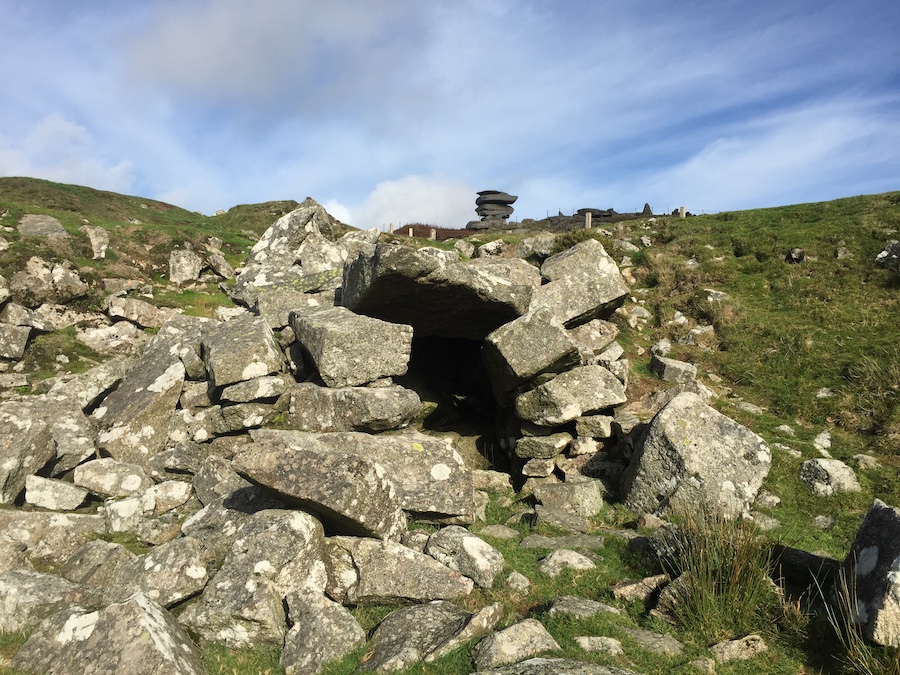
Not everyone was keen to urbanise. To save money on rent, Daniel Gumb made a cave for himself and his family to live in on Bodmin Moor. He was known as a mountain philosopher and used his granite roof as an observatory to stargaze and carve mathematical diagrams into the rock.
Arthurian Echoes
I cannot mention the known cast without mentioning those people wrapped in myth. Tintagel is said to be the birthplace of the legendary King Arthur. Tristan is a Cornish knight and fell tragically in love with the Irish Iseult, who was intended to be the bride of his uncle, King Mark. I love visiting these ancient places where old relics still stand, trying to imagine what it must have been like for those living back then.
Walking these paths and visiting these places connects me closer to both past and present inhabitants. Time travel is quite possible. All you have to do is walk and observe.
Leaving the Settled Land
The path diverges. If you wish, stay amongst the population. If you crave the quiet, take the path to the moor, or take the trail and be piskie-led into the liminal spaces.
Links: