Springs and Sacred Wells
Water springs from the ground. Fresh water – a vital necessity for life. Many springs have been turned into holy wells, often named after the local saint. I can imagine these sites were once attributed to earlier spirits and deities and repurposed by the church. But Cornwall did not quite forget the old ways. Visit one of these places, and you are likely to find the nearby hawthorns strewn with colourful clouties, along with spells and other offerings.
I recall visiting my friend and artist, Izumi Omori, for a weekend workshop. One of the first things we did was go to Sancreed holy well to collect water for use in our paintings. I love this kind of connective power between art and the tangible parts of the land.
Where Wood Meets Water
My favourite place, which weaves together woodland and water, is St Nectan’s Glen. Here, the path follows the stream, passing wind-felled trunks which glitter with a metal skin made of copper coins hammered ritually into the decaying bark. The flat rocks from the river bed have been carefully stacked into carns, and the rocky crevices hold small offerings. The ghost of a monk is said to walk this path. I know people who have seen him.
You hear the waterfall first. It cascades down the rock face into a small pool (kieve) before emptying through a hollow archway in the rock and into the stream. The air is cooled by the water’s fine mist. It is a peaceful spot and one close to my heart.
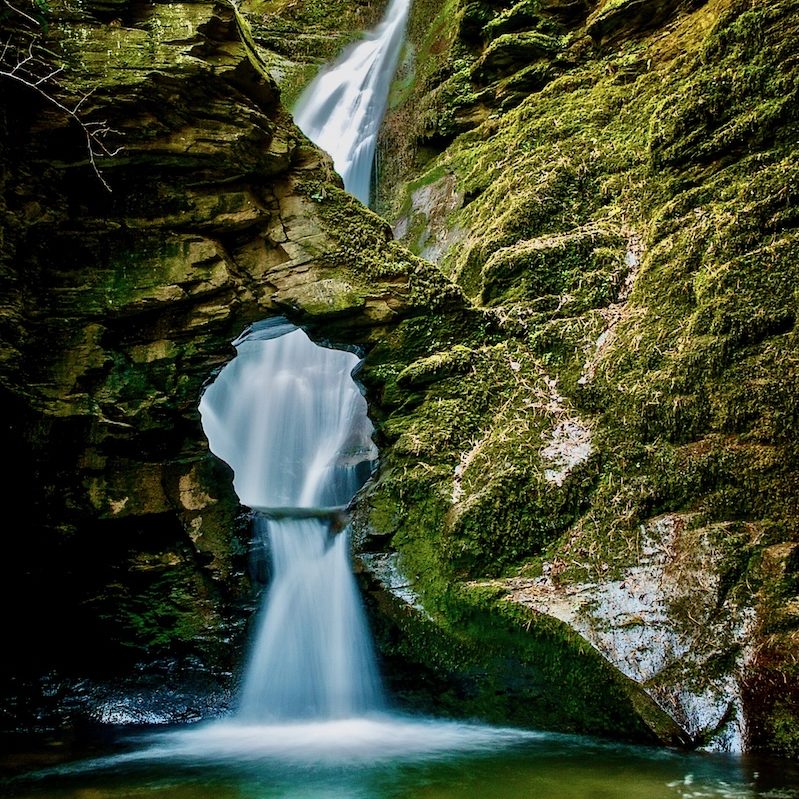
The damp air is filled by the sound of the waterfall.
Excalibur’s Resting Place
There are few notable lakes in Cornwall. Most are manmade reservoirs, but Dozmary Pool is one such natural lake, noted for its folklore. It is said to be the home of the Lady of the Lake and the resting place of Excalibur. Jan Tregeagle is also tied to the pool, for he is destined to find no rest until he empties it using a broken limpet shell.
Sylvan Paths
In the valleys are the wooded places. Walk through the sleeping woodland in winter when the sap is still and the canopies bare, save for the evergreens like the fir, holly and ivy. Last year’s growth has been shed onto the understory. A rustle and crunch of leaves beneath the feet of passersby. The empty husks and shells . The seeds, either eaten by the wildlife or hiding in the rotting leaves, waiting in the cold and dark for the spring to arrive. The wind sighs through the branches. Old limbs creak as they rub against one another. The birds flap and twitter. A deer passes through. At night, the jay’s screams would be replaced by the fox’s and the hooting owls.
I remember walking with my dad through the woods near Stowe. Suddenly, he wasn’t beside me anymore. I called his name, but there was no reply. I turned again, and there he was. Both of us were confused as we both called out for each other. There was no way we wouldn’t have been able to hear each other. Perhaps I was briefly piskie-led.
The Seasons of the Wood
Midwinter passes, and the days slowly lengthen. A blackbird welcomes the day with its song. Snowdrops break through. White is followed by the yellows of daffodils, celandines and primroses. In the oldest woods, anemones flower. The tree buds swell and burst with the first fresh greens of spring. Bluebells carpet the woodland floor as the low light scatters golden past the silvery-grey bark of the young beech trees. Blackthorn flowers shower the hedgerows like a bridal gown, followed by the hawthorn. I love this time of year. It shows Cornwall at its best with its colourful flowers and fresh greens. Out of the whole year, this is the time I love being in the woodland.
The sun rises higher and reaches its peak in midsummer. Campion and foxgloves gloss the wood with their showy pink flowers. The air hums with insects and the hiss of the wind through the leaves. Birds swoop through the branches and forage on the ground for food for their growing young. The canopy is changing. The fresh, lime greens of spring are now deeper.
Fruits ripen as the sun dips and the days shorten. Squirrels clean the hazels of their nuts. The jays take the acorns to bury for later. Sloes and hawthorns ripen. Apples weigh heavily on the branches. The windfall fruit is accompanied by the crimson leaves. The sap slows as winter sets in once more.
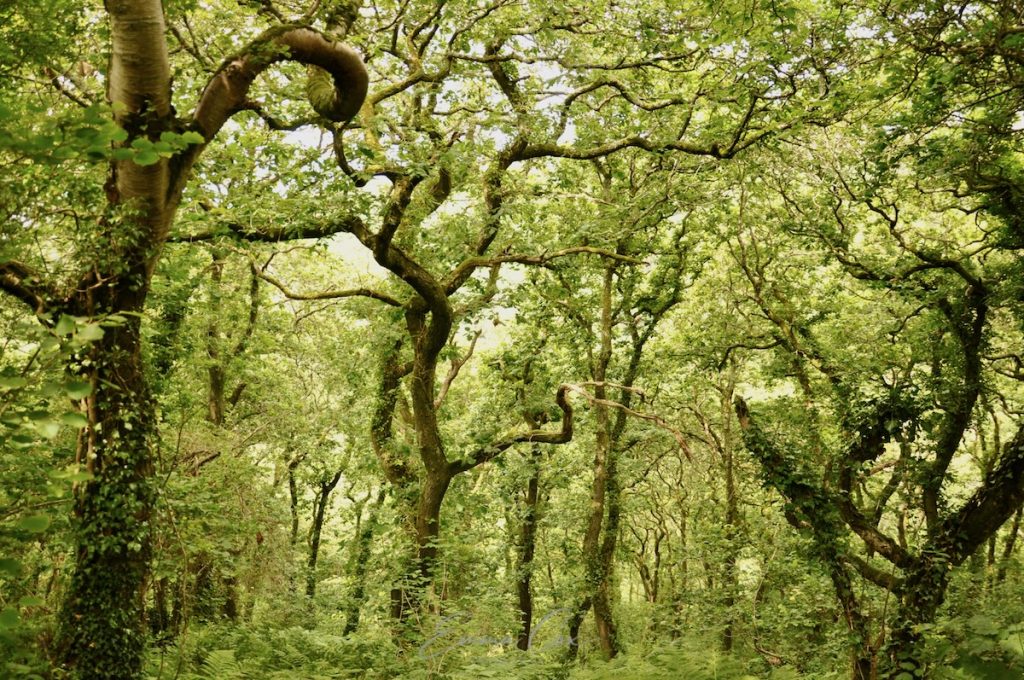
Woodland green at the high of summer.
Living Amongst the Trees
I spent three years living in an old stone cottage surrounded by woodland. Probably living the idolised “cottage core” and “witch core” dream! It helped me connect to the changing seasons. Before, I’d lived on the windswept coast, where trees were few and far between, and grew horizontal. So it was a different experience. I loved digging clay from the soil and collecting woodland greenery to make natural sculptures on the trunks. I coppiced hazel, twisted by honeysuckle, for staffs and wands. I took wind-felled birch and made my own besom broom, and harvested oak galls with the intention to make ink.
Ancient Forests and Nature’s Reclamation
Some woods, like those on the Dizzard, are ancient. Perched on a cliff and impenetrable. Shaped and stunted by the elements, the oak bark corkscrews as it strives for the light. Its limbs are home to thousands of moss and lichen.
Other woodlands have sprouted in places where industry has died. Kennel Vale woodland was once the site of a gunpowder factory. Old china clay quarries have become deep lakes, and the spoil heaps are left for species, old and invasive, to fight for space and light.
That is what the wood teaches me. There is always room for growth.
Leaving the Woods and Waterways
The path diverges. If you wish, stay amongst the shade and water. Or you can take the path into open fields and towards the village, or carry on and follow the river to the sea.
Links: