From the first lifeboats to modern competitive racing, discover the history of the iconic Cornish pilot gig boat.
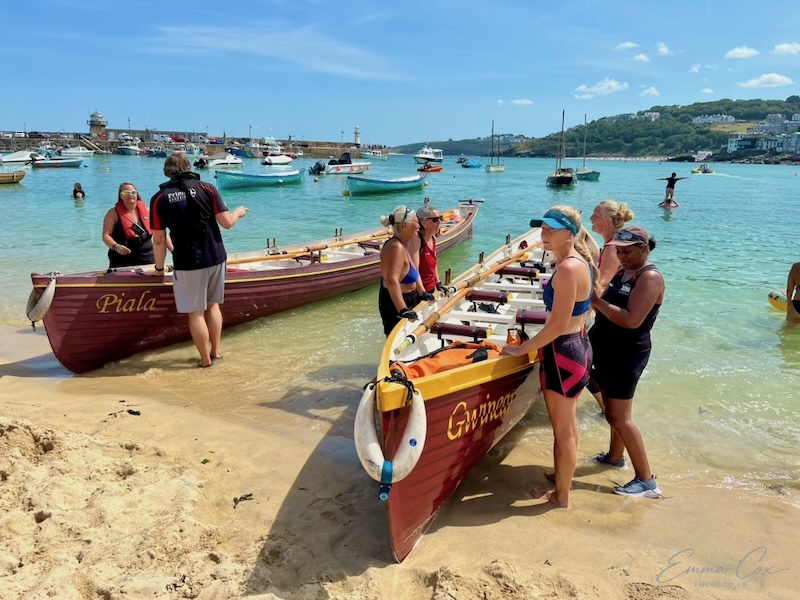
If you live or have visited Cornwall’s coast you’re likely to have seen a pilot gig—a six-oared rowing boat with a cox at the helm, clinker-built from Cornish narrow-leaf elm. Pretty much every Cornish coastal community has its own gig club hosting members of all ages and rowing levels. Just over a year ago, I joined Hayle’s gig club (which is enjoying its 50th anniversary this year) and I absolutely love it.
In this article, I’ll cover the history of the Cornish pilot gig, how it has adapted to the modern day, and the fundamentals of how to row one.
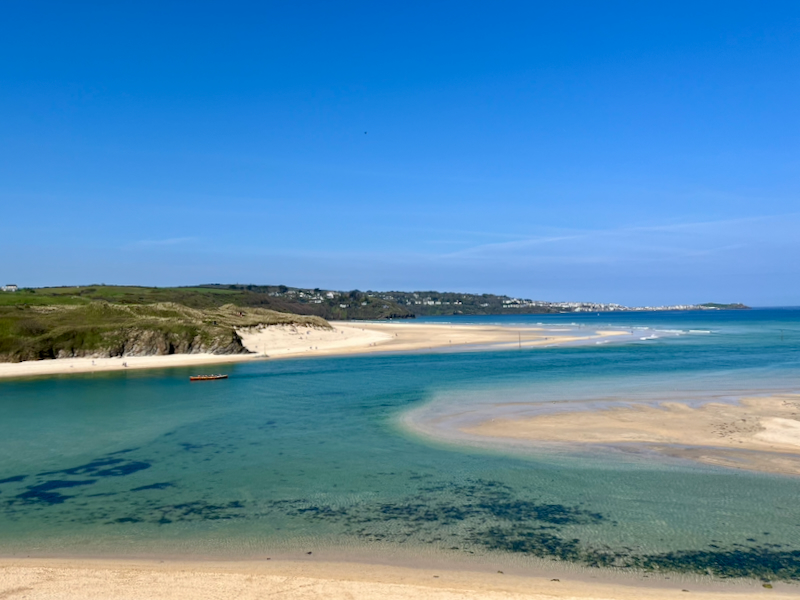
The history of the Cornish gig
The first known Cornish gig was built around the late 18th century. Its origins are hazy before that, but it’s likely the vessel was tweaked and redesigned over time to suit the conditions and desires of the task at hand. The gig was a multipurpose vessel ranging from honest work such as salvaging to transportation tasks to clandestine acts like smuggling. Before radio, it was a line of communication between the shore and the vessel. Gigs would row out with cargo samples, liaise with ships needing to dock for repairs, and carry pilots out to vessels.
Today, the word pilot conjures the image of aeroplanes and aviators. However, the word has long been used as a term for the helmsman of a ship. Its etymology can be traced back to the Medieval Greek pedotes meaning “rudder/helmsman”, derived from Greek pedon which means “steering oar.”
Gigs were used to transport maritime pilots to inbound ships. These pilots knew the local waters and could safely navigate the ship into the harbour.
Back then, it was first come, first served. Competing gig crews would race one another across the bay with the winner of the job being the first to board the vessel. A strong, fit crew with a good helmsman and impeccable technique meant more work and more income. However, that didn’t stop the inventive trickery used to get one up on their rivals. Gig crews would position themselves in coves where they could see their rivals from the neighbouring ports and race out ahead of them. A gig crew might sneak out before light and barefooted so as not to wake their sleeping rivals. No doubt they employed further mischief, like hiding their rivals’ all-important bung!
The first lifeboat
HM Coast Guard was established in 1822 with the purpose to prevent smuggling and aid ships in distress. Two years later, what would be presently known as the Royal National Lifeboat Institution (RNLI) was founded. However, it was common before and during the infancy of these two organisations for gigs to row to aid a ship in distress. Gigs were fast, nimble vessels manned by people who intimately knew the waters and risked their lives to act as first responders to shipwrecks. It is better for me to reference the words reported at the time to highlight their bravery.
“It was an awful scene —the moon shining at intervals through cloud which poured their contents on the foaming billows reckless of what they engulfed; and as the tide ebbed her stern hung upon a high rock with her head downwards, in this position her sails were shivering in the wind, and soon blown to ribbons… The master and crew were however fortunately saved just before she went upon the rocks by the courageous and praiseworthy exertions of five brave fellows in Fry’s pilot gig… who, regardless of the tremendous gale and foaming sea which nearly swamped the little boat, nobly brought off the poor fellows, four in number (including the captain)…”
West Briton and Cornwall Advertiser 27th November 1840
“A pilot gig put out from Hayle in the most daring manner, and with the greatest possible risk two or three times endeavoured to rescue the lives of their fellow townsmen; nor did they desist though repeatedly driven back, until their rudder was unshipped and the boat became unmanageable. They were vociferously cheered by thousands of spectators who lined cliffs, beach and sands.
Royal Cornwall Gazette 18th January 1866.
“The schooner Jane, of Padstow, Captain Worden, from Pentewan, for Liverpool, laden with clay, while coming into the harbour about four o’clock on Monday split her sail. The anchor was at once let go but she commenced to drag towards the Doombar. A pilot gig took off the crew, but still she drifted to the bar, and being struck by heavy seas capsized and soon went to pieces.”
Cornubian and Redruth Times 24th January 1868
With the inventions of steam, motorised vessels, and radio communications, the need for the oar-powered gigs declined. However, its modern-day resurgence is a nod to its historic roots.
Gig racing
Modern gigs are based on the Treffry, and are 32ft in length with a 4ft 10in beam. She was built in 1838 by William Peters of St Mawes and, amazingly, is still raced by Newquay Rowing Club.
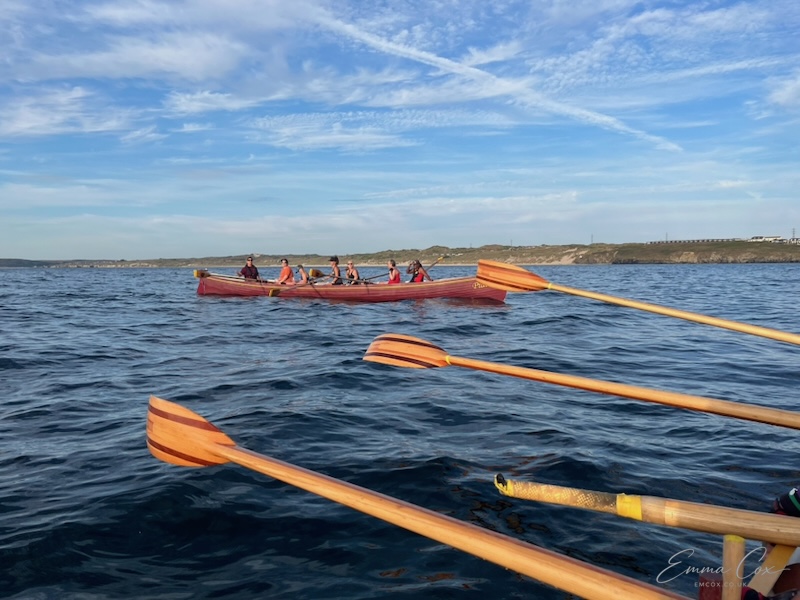
Like the original gig rowers racing to win work, the modern-day rowers race to win competitions. Many ports host their own regattas, and larger international events take place, including the World Championships held on the Isles of Scilly every May. The majority of gig clubs are found in the South West of England, but there is a gig club in London, and more across the wider world.
The Cornish Pilot Gig Association (CPGA) presently has over 90 clubs and 8000 active members. Some gig clubs take the big races very seriously while others do to the best of their ability. All of the clubs rely on membership fees and charitable funding to keep going and therefore are very community-driven.
The fundamentals of rowing a gig
It’s not an arm workout!
A lot of people assume you row with your arms. Yes, arms are involved, but Concept2 (who makes the popular and gruelling Ergo rowing machine) reckon it works 86% of the muscles in your body. To fully understand, we need to break down the rowing stroke.
The Catch
This is the start position. The body leans forward, legs are bent with the feet on the all-important spacer bar. Hands on the oar, the blade dips into the water with a slight tilt forward.
Wood and water are a perfect match. Learning the catch is about getting the blade depth correct. Too shallow, and you’ll lack power. Too deep, and you’ll be catching crabs (more on this later).
The Drive
In rugby they say “big thighs score tries”. The same is true in rowing, but without the memorable rhyme. The power comes from the legs as you straighten them. Your glutes, abdominals and back get a wake-up call as you lean back. The oar moves through the water. Your arms are still straight, and they are the last part of your body to move as you draw them into your chest.
The Recovery
The oar emerges from the water and the drive is reversed. First, the arms straighten and the rest of the body follows back to the catch position. If you were to tie a pencil to your oar, you would have drawn a rectangle. That is the shape of the stroke.
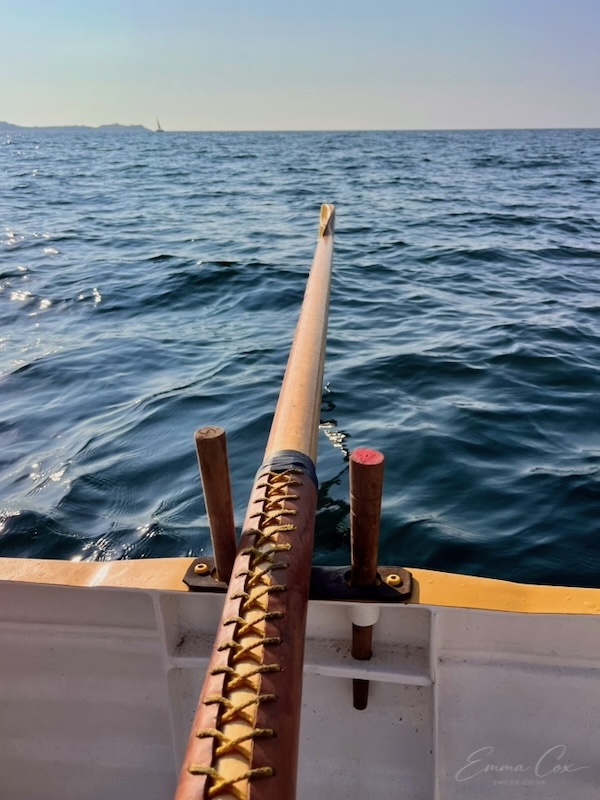
The oars are fixed in place by two wooden pins, one made of hardwood and the other softwood (soft cox is the term we use to remember which way round they go – innuendo bingo is another part of the club). Jokes aside, it’s a wonderful sound when all six oars are hitting the pins at the same time.
Catching crabs!
To catch a crab is when you lose control of your oar. This happens because the depth or blade angle wrong. The oar sticks fast, and you have to lift it out of the pins to regain control.
No slidey seats
Unlike indoor rowing machines or sliding seat rowing, your bum is static on a wooden seat on top of a nice pillowy cushion which will feel nonexistence after about an hour’s rowing. The repetitive rocking on your derriere usually causes some unwanted blistering commonly known in the community as gig ass. I can’t begin to tell you how often it gets talked about and all the methods club members use to try and mitigate it. Some people seem to be lucky and rarely get it. I am not one of those people. But don’t let me put you off trying out rowing; you only notice you’ve got it when you get home to shower!
Oars and Positions
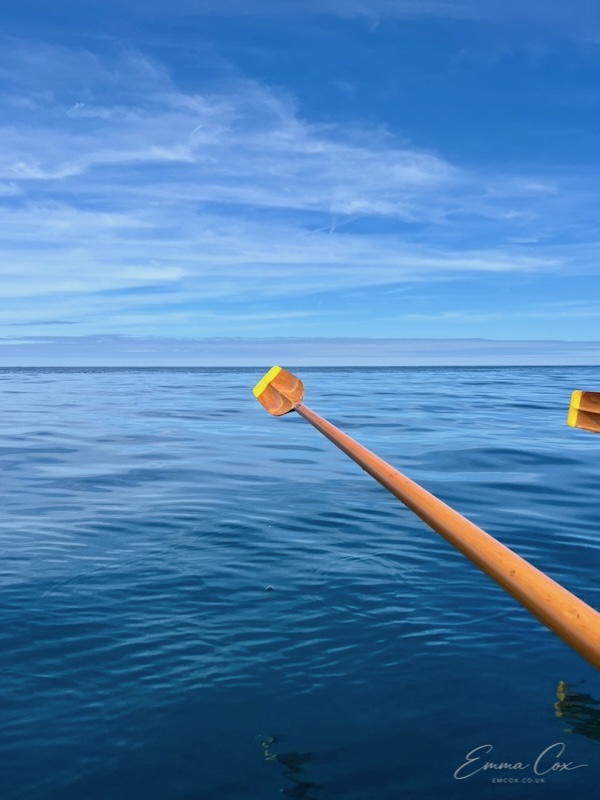
Oar 1 is the front of the boat, and 6 is at the back nearest the cox. The cox has the rudder, but can also command the crew to manoeuvre the boat (which is especially useful in race turns).
6, 4, 2 oars are stroke side. 5, 3, 1 are bow side. Honestly, it has taken me a year to drill this in my head. But even now the cox will call an order like, ‘Bow side, pull me round!’ and I have to think for a moment if that’s me or not.
All the oars have slightly different responsibilities. Generally, 6 and 5 are the ones setting the rate that 4-1 follow. Meanwhile, 4-1 are the engine and put in power when necessary.
When it comes to race turns, 5 and 2 get extra tasks. Oar 2 will set the rate and put the power in to get the boat round, while 5 will stick their oar in the water to act like a handbrake. Sometimes, Oar 1 will toss their oar over to stroke side during the turn to add a bit of extra power.
Customs and traditions
Folklore on gigs is a little thin. But like all boats, there is a ceremony and blessing for when the boat is named. Hayle Gig Club named their founding gig Isis, after the Hayle Lifeboat vessel. Isis was sold to another club, but has recently been repurchased. She is being repainted in club colours by its members and will be given back her original name in a traditional ceremony later next month.
I look forward to one day rowing in her. Honestly, despite being knackered in the cold and wet with blistered hands and arse, it’s great fun. There’s a wonderful community feel, and when you get those perfect summer rowing sessions out in the bay, it’s all worth it. Last week, we watched dolphins in the bay, and last weekend we rowed from Hayle across St Ives Bay, sneaked into their harbour and had a cheeky beer before rowing back again!
If you have a gig club near you, I thoroughly recommend giving it a go.