I’m currently drafting a gothic novel set in 19th-century Cornwall, meaning I have plenty of excuses to dive into rabbit warrens when it comes to researching local history and folklore. One main character has an ambiguous heritage, a bit like Heathcliff in Wuthering Heights. Not that you’d know this if your only experience of the novel were through the adaptations, in which the majority have cast a handsome white actor to play Heathcliff.
‘But who is this? Where did she pick up this companion? Oho! I declare that he is that strange acquisition my late neighbour made, in his journey to Liverpool—a little Lascar, or an American or Spanish castaway.’
Wuthering Heights – Emily Bronte.
In the 2021 census, 96.8% of people in Cornwall identified their ethnic group within the “white” category, which made me ponder what these figures might have been 200 years ago.
What the records tell us
The first census was made in 1840, but details were basic. Search birthplace, and we find people like Mary A Kewes, a dressmaker, and Peter Knight, a grocer, both living in Cornwall but born in Guinea. There is also John Alice, living in Falmouth.
Parish records are also hit and miss. However, the absence of written evidence doesn’t mean an absence of people. A burial record might indicate if the person was a gentleman or a pauper, but that’s the record keeper’s choice to include that. Most just put the name and the burial date. Occasionally, they mention ethnicity. In St Gluvias, near Penryn, whoever was writing things down was kind enough to give an insight. Here we know of four black people living in the community.
William Weymouth and Maria Blackall were married on the 28th June 1802
Samuel Steward, a mariner, married Grace Harris on 1st April 1806
John York, a sailor, buried on the 18th October 1757.
In Burdock, near Falmouth, John Rodney, mariner, married Elizabeth Stotten on the 18th March 1804, and witnessed by Joseph Emidy (more on Emidy later).
In Madron, near Penzance, there is a birth/baptism record in 1767 for Clarinda Harding (from Jamaica).
Before slavery was abolished, we also find evidence of slaves in Cornwall.
The baptism of Rachel Chapman, a black woman, and the property of Mrs Chapman of Fowey, 20th July 1746 in Golant, St. Sampson.
The baptism of Samuel Chapman, aged nineteen months, and the property of Mrs Anne Chapman in July 1743 in Golant, St. Sampson.
We find Samuel again in the same parish in 1763 when he marries Grace Crowle, and they have a son who shares his name, but there is no mention of his ethnicity or whether he is still a slave.
The life of John Alice
John Alice has already appeared on the census as born in Guinea and living in Falmouth with his wife and three children. But his name also crops up in the local newspapers.
Alice first appears in a report on the 1866 Falmouth Regatta. He briefly led in the swimming race but dropped to last place when he changed his stroke to doggy paddle. However, in the following year, Alice is back in the papers, this time in recognition for his bravery (and obvious swimming skills).
The Marmion, anchored in Gyllyngvase Bay, broke from her anchor and ran ashore. Three men from the Marmion ended up in the water and were rescued by Anthony Thomas, John Alice, and Captain Sherries. Alice was presented with a cheque for £5 for his bravery.
But what this article also tells us is how Alice ended up in Falmouth. The paper states he was of a high African class, but it’s unclear if this comes from Alice or if this is a perception by the white English gentlemen. He was taken to Brazil and sold into slavery where his owner hired him to shippers in Rio de Janeiro. He spoke little English, and it’s not understood if he came to an agreement with the crew of the Alice or if he concealed himself amongst the coffee bags he’d packed into the ship without anyone’s knowledge. However he came to be there, he withdrew from his hiding place once the ship was at a safe distance from the shore and presented himself to the captain. As nobody was going to turn the ship around, he became a crewman until the vessel docked in Falmouth. Needing a name to enter into the ship’s book, he was called John Alice. John, after the captain, John Truran, and Alice, the name of the ship.
Alice lived in Falmouth for over two decades and sadly died in a fatal accident in 1876 while working onboard a ship in London. His obituary in the newspaper states he was known as “a powerful hard-working labourer, sober, quiet, and tractable”.
Newspapers are always a good place for research. I stick to the local county newspapers to help narrow things down. Unfortunately, newspapers do tend to write about the bigger news stories, or the outright bizarre, rather than the day-to-day stuff.
The Ghost of Stoke Climsland
A ghost story tells of an enslaved black man who was brought by his owner to a mansion which once stood near the village. The master instructed the man to kill his wife, and then the master had the man murdered, and his ghost still haunts the site.
An argument over potatoes
On Christmas Day 1892, John Orr, a black sailor, was injured by Lawrence Morris onboard their ship docked in Falmouth. Morris was the cook, and Orr, along with another crew member, complained the potatoes had not been prepared properly. This resulted in a few potatoes being flung at Morris. In retaliation, Morris threw his carving knife. He had not meant to hit Orr, but the knife rebounded off the galley door and badly cut Orr’s arm.
An argument over furniture
Alice Quick employed Sally Hamblyn to look after her home while she was away visiting her blind daughter, only to return to find Hamblyn had sold all her furniture. In her defence, Hamblyn said Quick had frequent romantic visitations from an unnamed black man, and that Quick instructed Hamblyn to sell the furniture as she intended to pay her debts and elope with said man. As it so happens, the black man then sold Quick to an Irishman in a pub in Redruth for two pints of beer and a ring. By some means, Quick left the Irishman and returned to the Black man, demanding money and received 15 shillings.
Cornwall and the Slave Trade
Many Cornish families grew rich on the slave trade and held investments in plantations across the Atlantic. In Jamaica, it is clear to see Cornwall’s mark in place names such as Falmouth, in the parish of Trelawny, named after Sir William Trelawny. Documents survive from the Coryton family who list an estate in Barbados and the slaves worth noted in pounds of sugar. Abstaining from sugar, especially in tea, was one small method the Cornish used to protest against the slave trade.
The Perle
Although Britain abolished its Transatlantic slave trade in 1807, the institution carried on. Around the 9th December 1825, the Perle, a French vessel, arrived in St Ives harbour due to bad weather on her return from the coast of Africa with a crew of twelve men. The vessel was under the command of Julien Legue as the captain had died, along with the supercargo and eight others during the voyage.
Lieutenant Rye, of the coastguard, boarded and seized the vessel and the cargo hold was found to be adapted for the transportation of slaves. As well as the typical ship stores, there were manacles, shackles, and long chains to confine them in gangs, along with implements of torture. In addition to this, casks of palm oil were found, which were used to give black skin an artificial gloss to hide their ill health from the squalor of the conditions they were kept in.
Of the Perle’s slave cargo, five were found onboard, and one was a young boy. They were confined in the main hold with only sails to lie upon and canvas to protect themselves from the inclement weather. While the crew dined on boiled beef and fish, the slaves were fed on the pot liquor and entrails. Legue tried to present them as crew members, but none of them spoke either English or French, and possessed not even the most basic mariner skills.
An unnamed gentleman of St Ives tried to take the enslaved boy onshore. However, the French consul in St Ives argued the boy belonged to the Frenchman as much as the watch in his pocket and the hapless boy was restored to Legue, who said the boy’s sale would make him £40.
The people of St Ives weren’t backing down. Mr Hingstone, a known humanitarian of the community, got the solicitors involved to restore these slaves’ freedoms. The application was swiftly dealt with and the slaves were ordered to be brought onshore. Their reception was one of compassion, with many giving the freed slaves gifts of food or amusement.
Britain’s First Black Composer
The problem with relying on written records is not everything is written down. Joseph Antonio Emidy is one of Cornwall’s most well-known characters and Britain’s first black composer. His marriage to Jenefer Hutchins in 1802 makes no mention of his ethnicity. However, he was witness to the previously mentioned John Rodney’s wedding. Yet Emidy’s grave can be found in Kenwyn churchyard.
Here lie deposited the mortal remains of Mr Jos:h Antonia Emidy, who departed this life
Transcript of Emidy’s gravestone
On the 23rd of April 1835 aged 60 years.
And sacred to whose memory
This tribute of affection is erected
By his surviving family.
He was native of Portugal. Which country he quit about forty years since and pursuing the Musical Profession, resided in Cornwall until the close of his earthly career.
Devoted to thy soul-inspiring strains, Sweet Music!
Thee he hail’d his chief delight
And with fond zeal that shunn’d nor toil nor pain.
His talent sear’d, and genius mark’d its flight
In harmony he liv’d, in peace with all
Took his departure from this world of woe,
And here his rest, till the last Trumpet’s call,
Shall ‘wake mankind to joys that endless flow.
Emidy was born in Guinea around 1775, sold into slavery to the Portuguese and taken to Brazil as a boy. His master returned to Lisbon, along with Emidy. As the transportation of slaves to Portugal had been outlawed since 1761, this meant Emidy became a freeman when he stepped on Portuguese soil. Here, he became a virtuoso violinist in the Lisbon Opera and a promising musician.
Then came the British Navy.
The British frigate HMS Indefatigable was docked for repairs and the naval officers, including the Cornish captain Sir Edward Pellew, enjoyed a night at the opera. Impressed by Emidy’s violin skills (and in dire need of a ship’s fiddler to improve morale onboard while at sea), Sir Edward instructed his lieutenants to loiter round the theatre and press-gang (a polite word for kidnap) Emidy, violin and all, into the Navy. The ship’s muster books simply list Emidy as a volunteer, where he spent the next four years reducing his creative talent to loathsome jig music to entertain the crew.
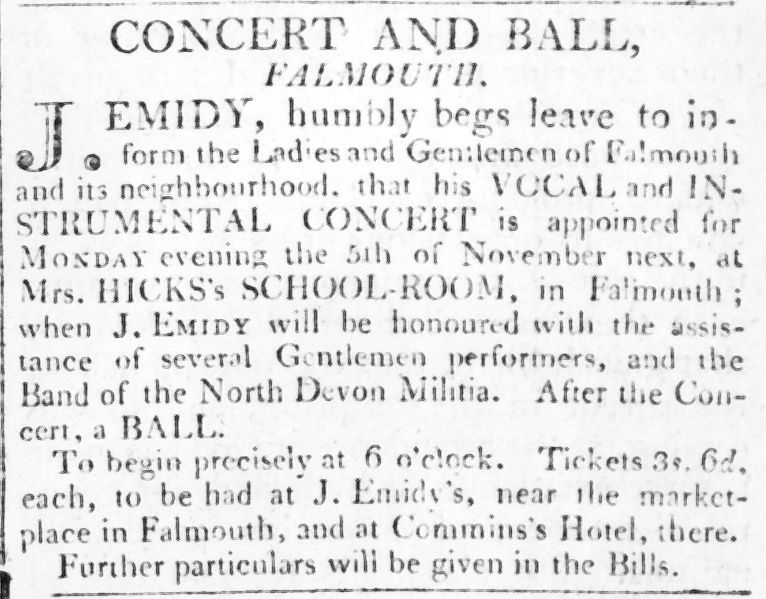
Emidy was eventually discharged at Falmouth, Cornwall, in 1799, having never once been allowed onshore as Sir Edward knew Emidy would leg it at the first opportunity. Emidy made a living as a teacher and a violinist. He married Jenefer Hutchins and had eight children. After moving to Truro, he established its Philharmonic Orchestra and went on to become one of the most celebrated and influential musicians in early 19th-century Cornwall. Emidy’s Annual Concert and Ball took place every December. Sadly, no copies of his composed works are known to survive, but the names of some of his works remain, captured in old newspaper articles. The Blue Bells of Scotland, his Concerto on the Violin and Concerto on the Bugle are but a few.
“Mr Emidy’s Concerto on the Violin, has seldom been excelled, either in composition or execution.”
– Royal Cornwall Gazette 17 December 1814
One newspaper critic does note that the concert in 1815 did go on a bit. A whole four hours, in fact. The Ball part of the evening didn’t kick off until after midnight, and everyone was still dancing until gone three in the morning. Sounds like a good night to me!
Notes
- https://www.ons.gov.uk/visualisations/censusareachanges/E06000052/
- https://www.opc-cornwall.org/deaths/falmouth_death_alice_john_1876.pdf
- https://www.opc-cornwall.org/news/falmouth_news_bravery_awards_1867.pdf
- Royal Cornwall Gazette 5 Jan 1893
- Penzance Gazette 29 January 1840
- Manchester Guardian 14 January 1826
- https://en.wikipedia.org/wiki/Joseph_Antonio_Emidy
- https://kresenkernow.org/wp-content/uploads/2022/10/Kresen-Kernow-collections-guide-the-Transatlantic-Slave-Trade-and-the-Caribbean-revised.pdf
- https://www.classical-music.com/features/artists/joseph-emidy