The traditional oral storytellers who kept the old Cornish tales alive
The Odyssey has shot up in the book charts since the new blockbuster came out. The deviation from Homer’s ‘original’ source material has given many a journalist and writer an excuse to fill newspapers and online articles with their opinions, including Emily Wilson, whose translation inspired Nolan’s film.
This is where I am going to stop talking about The Odyssey (as I have noted, there is enough elsewhere). What I want to tell you about are the Droll Tellers, the Cornish storytellers who would make Nolan’s adaptation look positively faithful to the source material.
The original Celtic storytellers
If we go back two thousand years, we have accounts by Greeks and Romans of the Druids in Gaul and Mona. One culture describing another is always dubious, especially in the Romans’ case, who were in conquering mode. What is generally agreed is the Druids orally passed on their knowledge, so their teachings and stories continued through the generations. Sadly, we only have the archaeological remains and folklore to try and piece together what these Celtic tribes were truly like.
The Welsh Triads
The Welsh Triads is a medieval text and a wonderful mix of history and myth. The earliest surviving documented parts are from the 13th century, and the latest from the 18th century, written by Edward Williams (who went by his bardic name Iolo Morganwg). The latter’s work raised eyebrows about its authenticity, so many question if they are purely his own invention.
Three things not easily restrained, the flow of a torrent, the flight of an arrow, and the tongue of a fool.

- Triads of the Island of Britain (Trioedd Ynys Prydein)
Morganwg’s work claims one of the three principal gorseddau of the Island of Britain is “Beisgawen yn Nyfnwal” (Boscawen in Dumnonia), which has been taken to refer to Boscawen-Ûn stone circle in Cornwall. Gorseddau is Welsh for throne (in Cornish it is gorsedh), and is generally thought to be a druid/bardic meeting place.
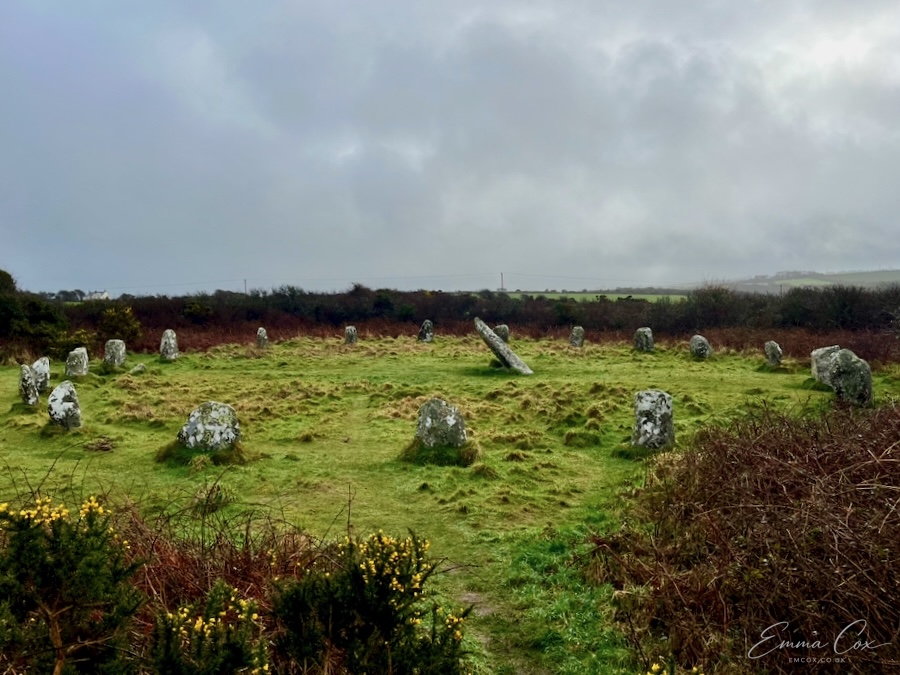
Boscawen-Ûn is Cornish for “the dwelling by the elder trees” (elder is associated with the fairy realm by Celtic cultures). Is it plausible this name went back centuries? Probably not. Many ancient sites and monoliths are named after the nearest farm. But it is a nice story. So nice, Henry Jenner set up Gorsedh Kernow in 1928. The group’s aims are to preserve Cornwall’s language, history, and culture through poetry, song, dance, music, art, sport and spoken word.
Undisturbed by the shriek of the railway whistle, the giants and fairies, the pixies and mermaids still found a place in the imagination of the Cornish folk.

- Cornish Telegraph 26 November 1908
Cornwall’s Droll Tellers
Droll Telling was a profession. Before the internet. Before telephones, steamships and railways. In a time of high illiteracy rates, you got your news and entertainment from travellers boarding in your home or at the village pub. Once the day’s chores were done and it was too dark to work by candlelight, it was handy to be in the company of a droll teller. They were storytellers and historians, passing and keeping the myths and lore alive. There were grand stories of King Arthur, uncanny tales of giants, ghost stories, and tales of ordinary Cornish people. Droll tellers spoke of Cornwall and its identity.
Droll tellers are also verbose. They do not believe in tightening their prose. Elaborate descriptions? Yes. An excuse to meander off on some backstory? Of course. Editors today would hate them.
Every storyteller wants to leave their mark, and no story will be told in quite the same way. Embellishments occur. Interpretations are adapted. Would a droll teller of old be happy to change the story to suit the audience? Well, they’re the ones giving them a bed and a hot meal in payment. Telling a tale to a group of women? They might strengthen and embellish the romantic elements. Telling the same tale to some men in the pub? Then play down the romance, big up the heroics and throw in some gore. The winter nights are long, and a droll teller does not always hurry with their tale. One account by William Bottrell mentions a tale being told over four evenings because the droll teller enjoyed honing in on the details. They did not simply mention the giant’s castle in a passing sentence, but described it in minute detail, giving the listeners the information to paint a picture in their mind of the scene they were describing.
Uncle Anthony
The surviving names of these droll tellers are few. Anthony James (generally known as Uncle Anthony), a blind droll teller, was accompanied and assisted by his boy (who played the fiddle) and his enormous pet dog. Together, they travelled the county every summer, telling drolls and singing ballads. Uncle James’ favourite drolls were ones of romantic seductions, wooing mermaids, and Cornish giants and heroes. He is said to have told a frightful ghost story of King Arthur. In it, Arthur haunts the ruins of Tintagel Castle lamenting the faithlessness of Guinevere, who sometimes appeared on the cliffs from which she would leap into the sea. In the winter, James stayed with the other pensioners in Plymouth, but was often summoned to gentlemen’s houses who wished to hear him sing and tell drolls about Sir Francis Drake.
Preserving the old tales
Robert Hunt
Robert Hunt (1807 – 1887) was a mineralogist by profession, but had a plethora of other interests. He was an early pioneer of photography, wrote poetry, and collected and wrote Cornish folktales.
He was born in Plymouth Docks, Devon, and lost his father in the same year when his ship and all crew were lost. With maternal family originating from Cornwall, Robert grew up in Penzance, and later moved to London to pursue his profession. However, a chronic illness saw him routinely returning to Cornwall to recuperate. An inheritance from his grandfather gave him the funds to explore Cornwall and collect the droll tellers’ stories.
Fiction resolves itself into its primitive elements, as by the slow and unceasing action of the rain and wind the solid granite is crumbled into sand. The creations embodied by the vivid imagination of man in the childhood of his race, incorporate themselves in his fond and mistaken faith; and the fable, reduced again to its original simplicity and nudity, becomes the fitting source of pastime to the untutored peasant and the listening child. In these wild old tales is concealed the pure and primitive mythology of our ancestors which has been considered as lost forever.

- The West Briton 30 September 1864
It was at this time we see the Cornish reclaiming their lost culture and Celtic heritage. Henry Jenner, who I mentioned earlier, did much to record the dying Cornish language. Hunt’s work, Popular Romances of the West of England, or The Drolls, Traditions, and Superstitions of Old Cornwall, published in 1865, kept alive the stories we would have lost with the advancement of technology. One whom Hunt spoke to was William Bottrell (1816–1881), who went by the moniker the Old Celt.
William Bottrell – The Old Celt
Bottrell was born in Levant, Cornwall (near Treryn Dinas if you want a flavour of the folklore he provided) but did not stay for long. He travelled widely, living at times in both Spain, Canada and Australia. One common theme in all his travels was his curiosity in the local folklore. He knew enough Cornish drolls from his childhood. But eventually, circumstances brought him back to settle in Cornwall. Later, he met Robert Hunt and told him drolls for his book.
Some few of our story-tellers have lately, however, shown common sense and better taste; amongst others Mr. Robert Hunt, who made so free, enjoyed our jokes so much, that we were always glad to ‘touch pipe’ and tell him a droll whenever he came amongst us, because he seemed to like the fun so much.

- William Bottrell writing in The Cornish Telegraph 01 May 1867.
Bottrell was acknowledged, but it spurred him to write and publish his own collection of Cornish folktales. They differed from Hunt’s concise storytelling. Bottrell was a droll teller. He wasn’t going to stick to the simplified original tale. No, he was going to embellish it. He was going to entertain!
For example, I briefly told the story of the Cury Mermaid in a previous post. In The Cornish Telegraph on 7th April 1869, Bottrell writes a whole column’s worth on the tale. The bones are of a man who finds a mermaid in a cave and carries her to the low tide. But Bottrell includes not only the gift of a mermaid comb, but also the man (named Lutey in this telling) is granted three wishes, giving him the powers of a white witch. Bottrell describes the mermaid’s underwater home as she tries to entice Lutey beneath the waves. In this tale, she is mischievous. Not a moment too soon, Lutey realises what she is trying to do and escapes her. The mermaid vows to return in nine years. In those nine years, Lutey uses his newly bestowed powers. Yet his tie to the mermaid never truly severs. Nine years pass. Lutey is on his fishing boat and the mermaid surfaces. This time, he is powerless. He dives into the sea, never to be seen again.
These hearthside stories bear the strongest impress of orally transmitted legends which it has been the ‘labour of love’ of one born in the midst of the region whence they sprung to collect and commit to writing.

- Cornish Telegraph, 22nd March 1871
Bottrell originally published these drolls weekly in the Cornish Telegraph and went on to write two volumes of Traditions and Hearthside Stories of West Cornwall. A third edition had been in the works. However, Bottrell had a stroke, leaving him unable to write. What he had written for the planned third edition ended as the much shorter book Stories and Folk-Lore of West Cornwall.
One poor moment can suffice
To equalise the lofty and the low.
We sail the Sea of Life. A calm one finds
And one a tempest. And, the voyage o’er,
Death is the quiet haven of us all.
If more of my condition ye would know
St. Levan was my birthplace, and I sprang
Of Cornish parents. Sixty years and five
Lived I: then yielded to a slow disease.

Death of Mr. William Bottrell, of St. Levan - “Old Celt”
Cornishman, 1st September 1881
Thomas Quiller-Couch
Quiller-Couch (1826-1884) was the second son of naturist Jonathan Couch. He trained as a surgeon and worked as a doctor in Cornwall. He was also a botanist, artist and collector of folktales and traditions. Robert Hunt acknowledges Quiller-Couch’s contribution in his published work.
With thanks to these three gentlemen, these Cornish traditions, drolls and superstitions live on, despite our diminishing attention spans. Today, modern storytellers keep those tales alive, while adding our own embellishments. But these tales are likely to be only a small portion of those spoken centuries ago. However, Cornwall still retains its magic and charm, invoking new stories to entertain.
The Cornish drolls are dead, each one;
The fairies from their haunts have gone:
There’s scarce a witch in all the land,
The world has grown so learn’d and grand.

Henry Quick (1792-1857), Cornish Poet
Notes
- https://www.cornwallheritage.com/ertach-kernow-blogs-2022-2023/cornish-folktales-and-stories-saved/
- https://talesofbritainandireland.com/william-bottrell/
- Cornish Telegraph, 04 March 1903
- Cornishman 30 January 1879