Carn Kenidjack holds a treasure trove of ancient history and folklore. It is situated by the Gump (Woon Gumpus Common), which is the place to go if you want to get pisky-led by mischievous fey creatures.
Carn Kenidjack is one of those places which has a character of its own that draws people into embellishing it with unexplained tales.
When it comes to supernatural senses, I barely register anything. I holidayed at a cottage on the Welsh border, and the bathroom had an unsettling ghostly presence that everyone but me felt. I didn’t mind doing my ablutions in there. No one else would go near it. We even got the gardener, who’d never been in the house, to go into the bathroom, and she just burst into tears and ran back outside! So I do not say this lightly when I say I’ve given Carn Kenidjack the moniker Scary Place. Even I felt unsettled up there after the sunset. More on that soon (or skip down to Uncanny Happenings).
Kenidjack derives from the Cornish Keunyjek, which means ‘place abounding in firewood ’, harking back to a time when the area had a few more trees about. However, an article in Cornishman and Cornish Telegraph from 1930 has a much more evocative meaning, which is ‘the ridge of the flying serpent’. Hmm… I’d like to believe the latter, but I think the former is more likely. This is a shame. I’m all for dragons. Nearby Porth Naven is a beach which is littered with smooth, granite boulders which look like dragon eggs.
A geological feature steeped in history
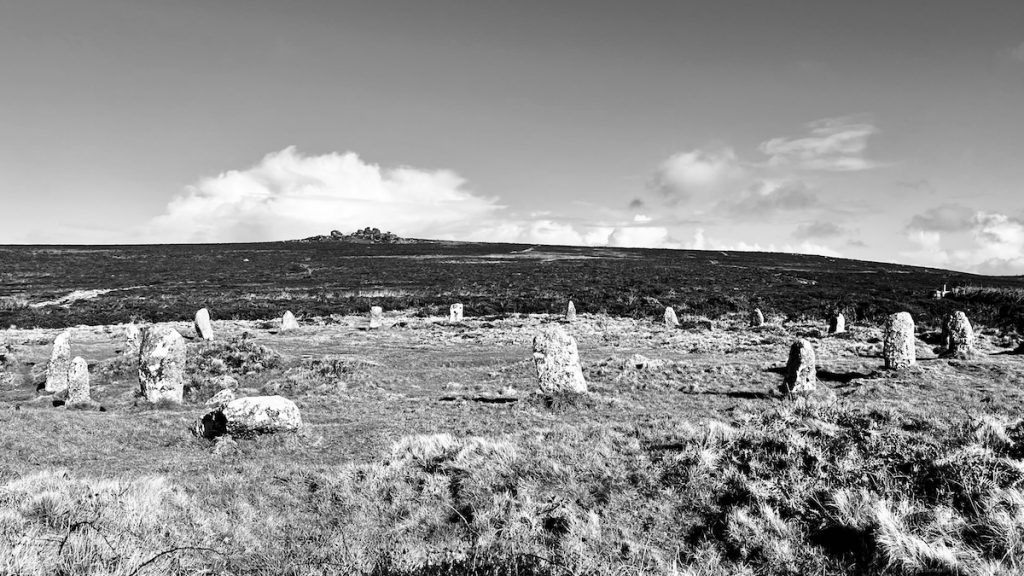
Carn Kenidjack is a hill in Tregeseal with a granite outcrop at its summit. It often goes by its other name, the Hooting Cairn, due to the otherworldly sound the wind makes as it moves across the rocks. In prehistoric times, it was a much busier place. At its feet, you will find the Tregeseal stone circle. It is also called the Nine Maidens, which is a popular name for a stone circle. Imagine the patriarch warning young women to do as they’re told or they’ll end up turning to stone as those maidens did for dancing on the sabbath. This folklore stems from the rise of Christianity, where traditional beliefs were reimagined as the Devil, and the ancient stone remains left by the ancestors were physical reminders of the power God had if people didn’t behave. What remains of the monument is (sadly) rather little. A few larger gaps between the stones suggest there were 21 stones rather than the remaining 19. It is known there were two, potentially even three, stone circles at this spot, mimicking the Hurlers monument on Bodmin Moor. There is no substantial evidence to confirm the third circle, but remains of the second can be found in the neighbouring stone wall. The rest, destroyed by the landowner at the time for farmland. Let’s hope the piskies gave him a few things to gripe about.
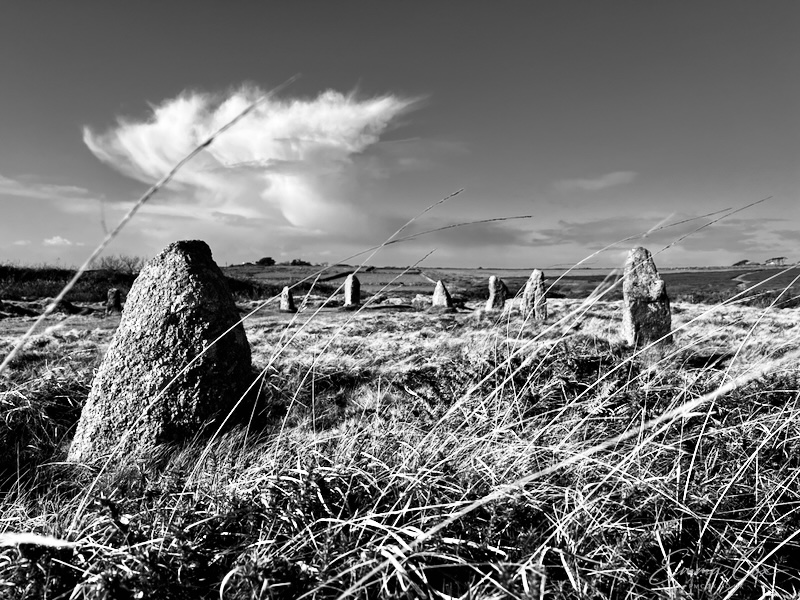
The stone circle isn’t the only ancient thing local to Carn Kenidjack. There are a good number of burial sites, an ancient settlement, and a number of holed stones (although there’s an argument these might be much more recent). On top of Carn Kenidjack, there is also a propped stone.
We liked rocks back in prehistoric times. I still do. Don’t you? I bet you’ve taken a pebble home from the beach you liked the look of. Back then, we had fun with rocks.
The Ancient Stone Bothers
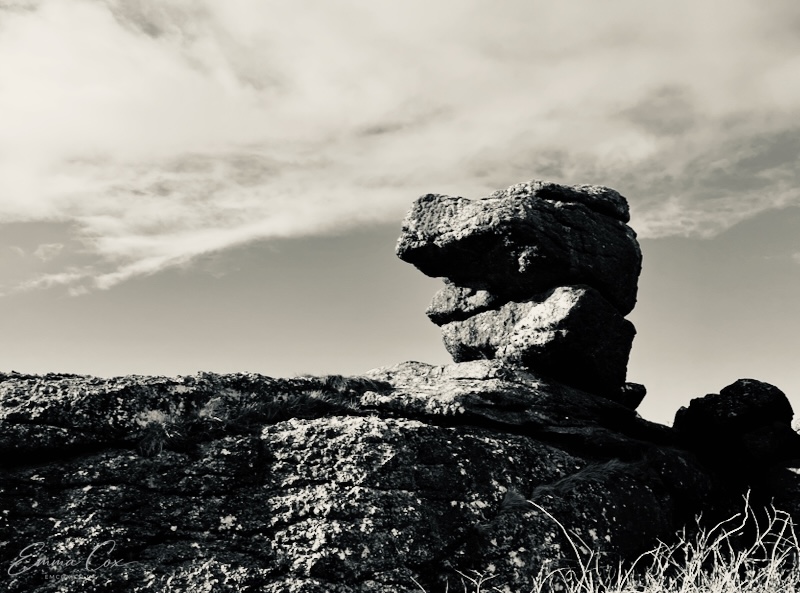
We liked rocks back in prehistoric times. I still do. Don’t you? I bet you’ve taken a pebble home from the beach you liked the look of. Back then, we had fun with rocks. If our ancestors weren’t making cairns and stone circles from them, they were adjusting them in the landscape. One prominent stone slab on Carn Kenidjack is propped on two smaller stones. Standing at neighbouring Chun Quoit on the winter solstice, you’ll see the sun set behind this exact rock, so the situ has meaning. These are deliberate marks on the landscape, very much like numbers on a clock to help tell the time; however, these mark celestial events. Also, these rocks (which are natural) have been specifically placed (so they look unnatural), making them a useful tool when travelling. Delve into the subject of leylines (I recommend The Old Straight Track by Alfred Watkins), and you will discover hilltops, cairns and deliberately placed stones are often markers guiding the way. The problem is such stones which look unnaturally placed are in fact natural geological occurrences, and it’s not always easy to tell. This one at Carn Kenidjack appears to be deliberately positioned as the grain in the propped stone ran in a different direction from the rest of the outcrop. To look at the granite outcrop, I am almost inclined to imagine it as a place for sky burials.
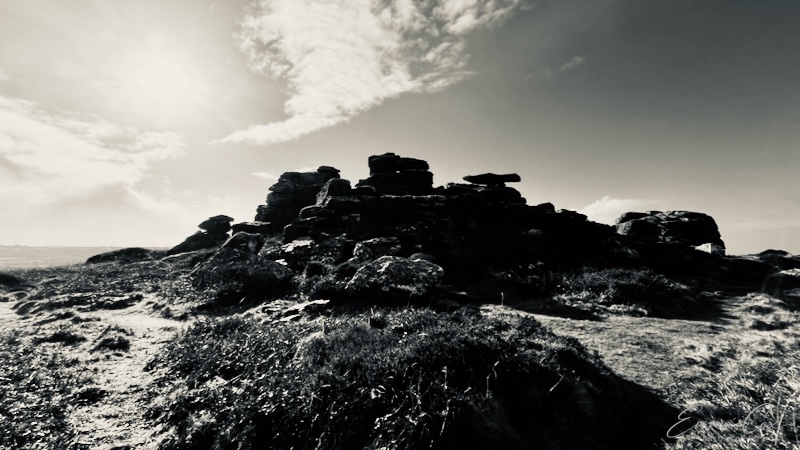
But the fun didn’t stop there. Simulacra rocks crop up a lot (there are a lot of faces in the rocks around this part of Cornwall). These are mostly natural and are potentially why people were drawn to the site in the first place. However, we can’t always rule out a little touch-up by human hands. Our ancestors were excellent stone botherers.
Farming and mining have also left their scars on the landscape. But I’m more interested in the plethora of folklore attached to this spot. So, why do I call it Scary Place?
Uncanny Happenings
My partner and I combined two of our favourite things (rocks and photography) in a visit to Carn Kenidjack and Tregeseal stone circle. For added atmosphere, we went for sunset. Generally, moorland is evocative of vast emptiness and solitude. Here, despite no one else being around, you never shrug off the feeling of a still and silent audience watching you. Even me, who isn’t tuned into the uncanny, noticed it. The sun dipped below the horizon, leaving us in the gloaming.
I am not new to nocturnal jaunts on the moor. Not even passing the place where poor Charlotte Dymond was murdered and where she is said to haunt was creepy. I’ve been up in the early hours photographing the Milky Way with an ancient tomb in the foreground. This isn’t novel. But there was something seriously creepy about walking from Tregeseal stone circle and past Carn Kenidjack in the deepening twilight. The breeze whipped through grass and gorse and moaned through the silhouetted rocks. But what unnerved me was the palpable sense that the still and silent audience from earlier moved with me. The body is a sensor, and something picked up the sensation of others running and passing me on the path. But no one was there. And yet, whatever I sensed had child-like mischievousness and a similar stature.
If I had indeed experienced something uncanny on Carn Kenidjack, who are the likely culprits? Let’s delve into the folklore.
Humans, being humans, who can’t even resist taking the soap from a hotel bathroom, cadge what they can. Many have secretly pocketed gold and jewels from the Small People, but come the morning, they find only withered leaves and empty snail shells in their pockets.
Piskies, Spriggans, and Small People
Piskies are said to look like weird, wizened-looking, little old men. Their favourite mischievous habit is to lure people into bogs with a fey light. Spriggians are dour and ugly sprights who hang around old ruins and where treasure is buried. They are the antisocial hooligans of the supernatural, since they steal children, summon bad weather to blight crops, and generally cause mischief if you happen to step on their patch. The Small People are fair, kind and pleasant. It’s good news if you spot one and even better news if one takes a liking to you as they will do much to please you.
The Gump where Carn Kenidjack is situated is a hot spot for such creatures. Many travellers over the centuries have ended up lost due to their antics. One story tells of Grace, who lived beneath Carn Kenidjack. She met a widower on the Gump and went into his service to look after his son. His home and lands were idyllic, but there were rules to follow, and curiosity led her to break them and discover he was a changeling who, for nine years at a time, could appear as a human. The changeling returned her back to her parents home beneath Kenidjack with bags laden with gold and finery. She believed she had been gone for a year, but nine had passed by.
One individual happened upon a fairy feast at Tregeseal stone circle. The Small People weren’t best pleased by this gatecrasher, so they tied him up in gossamer, where he was discovered the following morning. The Small People are sometimes kinder and don’t mind the humans who stumble upon them and enjoy their festivities. Humans, being humans, who can’t even resist taking the soap from a hotel bathroom, cadge what they can. Many have secretly pocketed gold and jewels from the Small People, but come the morning, they find only withered leaves and empty snail shells in their pockets. If you don’t want to be pisky-led, the best fix is apparently to turn your coat inside out.
The Devil
As Christianity grew in popularity, the folklore changed. Perhaps these are new tales or tales where the characters have changed, and the story has been tweaked; we’ll never know. However, the Gump is also the Devil’s hunting grounds. He rides half-starved horses, terrorising any poor soul who might be crossing the moor after nightfall. Carn Kenidjack is also the venue for the Devil’s wrestling matches. Two miners travelling across the moor after dark saw strange lights and heard an otherworldly din coming from the Hooting Cairn. A rider met them on the road and urged them to come with him to the light and noise. At the Carn, the two miners found a wrestling match was about to take place. Yet the fighters and the crowd were not human. Neither was the rider, for he was the Devil, there to play stickler to this match. The two men watched the spectacle in horror as the two wrestling demons fought and the demonic crowd cajoled them on. The Devil watched on, smiling. The hoots and howls grew louder when the match ended. The miners whispered a prayer into the defeated demon’s ear, and the whole spectacle vanished before their eyes.
Old Moll, the witch.
Old Moll was a powerful witch who lived on the Gump and near Carn Kenidjack. Her legacy was to be remembered by the terror she inflicted on people, tying them in spells that could not be broken. Even in death, Old Moll didn’t disappear. She haunts the Gump and continues tormenting people. One story tells of a young woman whose brothers forbade her to draw water from the well after dark. Inevitably, a night came where she did have to venture across the tract to the well. She meets an old woman wearing a red shawl sitting in a gap in the hedge by the well. She bade her good evening and received no reply. Rude, she thought. The young woman put her pail in the well, saw and heard it fill with water, yet when she drew it up, the pail was empty. She tried again, but the same thing happened. She kept trying and… you get the picture. The young woman was getting worried at this point. She spoke again to the old woman and, once again, receives no reply. Proper scared now, she runs home to her alarmed brothers. They explain she’d seen the ghost of Old Moll, and they saw her sitting in the gap in the hedge every night before going to bed.
Did I have a close encounter with one of the above? Probably not. Perhaps the eerie wind fired up my senses to find dangers which weren’t there. Or it is because Carn Kenidjack is one of those places which has a character of its own that draws people into embellishing it with unexplained tales.. But I haven’t had anything similar happen before, and I’ve yet to attempt a return trip at dusk.
Notes:
- Traditions and Hearthside Stories of West Cornwall – William Bottrell
- Cornish Feasts and Folk-lore – M. A. Courtney
- Popular Romances of the West of England – Robert Hunt
- The Romance of the Stones – Robin Payne and Rosemarie Lewsey
My articles are free to read. If you wish to support what I do, please donate through my Kofi page.