Never be afraid to try new things and take your creativity down a different path.
It’s easy to settle into a comfortable creative routine. Shy away from trying something new because your method works and why change it? This week, I was reminded of the unexpected delights and benefits of giving some new a go, and how it can enrich my creative process and give my enthusiasm a much needed kick up the backside.
Bear with me while I discuss this revelation using Ian Livingstone’s and Steve Jackson’s Fighting Fantasy books as an analogy. These were one of my childhood staples, and (honestly) I’m still a fan. My top three? Forest of Doom, City of Thieves, and The Warlock of Firetop Mountain. I’ve got a 25th anniversary signed edition of the latter. (Looking at the front matter, I note this edition was printed in 2007, nineteen years ago!)
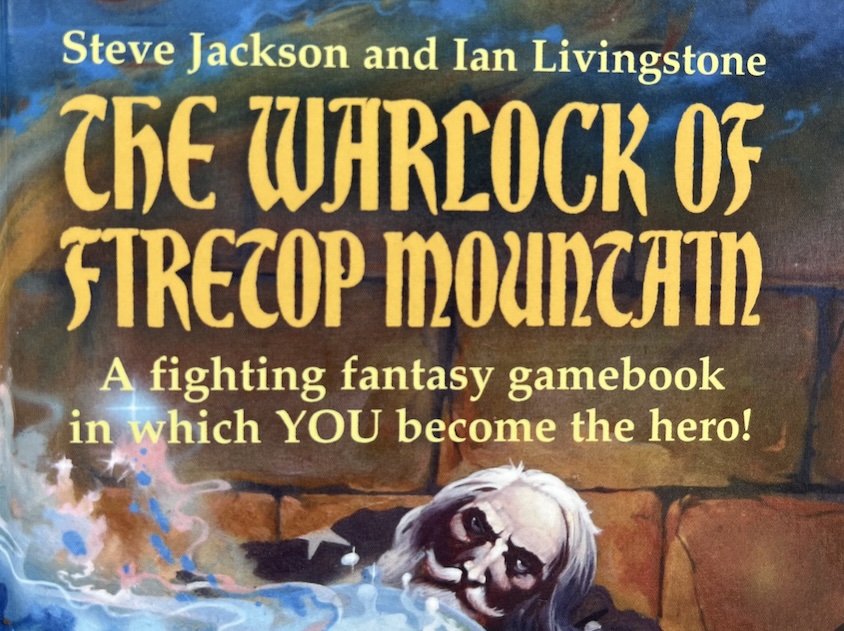
They were one of my early introductions to the fantasy genre, and came with the added benefit of being both a story and a game. Like modern video games, where the storyline can shift depending on the main character’s actions, these books made you an active player in the hero’s fate. Take the door on the left (turn to 149). Take the door on the right (turn to 29).
Now you’re probably wondering how I’m going to link this creativity.
Creativity isn’t linear
This week, I discovered The Writers’ Block in Redruth was holding a competition to win one of eight placements on their Emerging Playwrights training programme. The course would be paid for by the Minack Theatre, and one lucky winner would also get to see their play acted at the iconic Minack.
For those who don’t know, the Minack is an open air theatre built on a cliff edge above Porthcurno, Cornwall. It was designed and built by Rowena Cade, who moved to Cornwall in the early 1920s. With only hand tools and the odd well-placed stick of dynamite, Rowena and her workers built both the theatre and Minack House, where she lived.
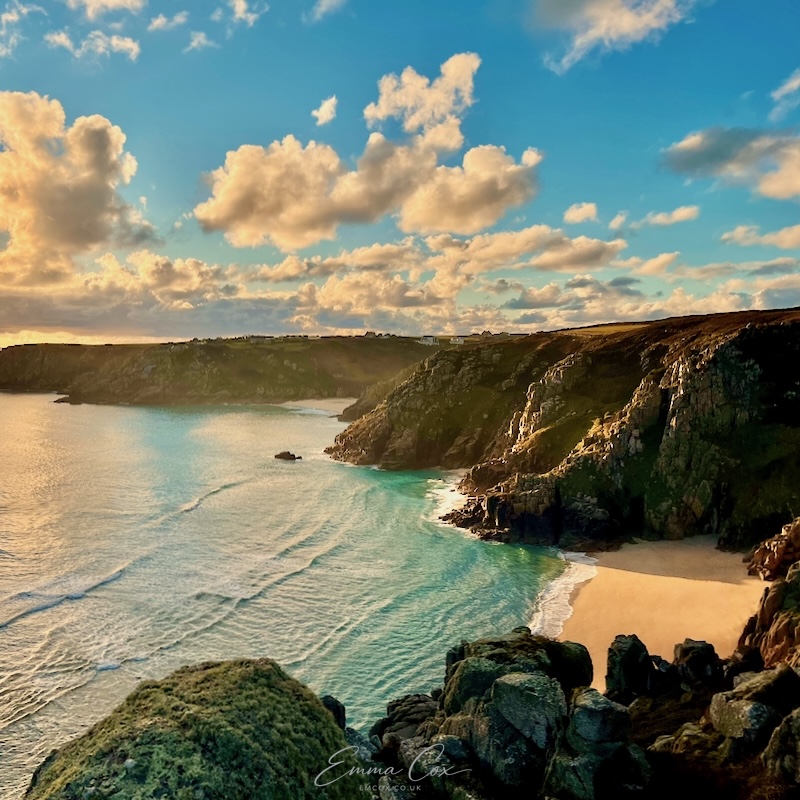
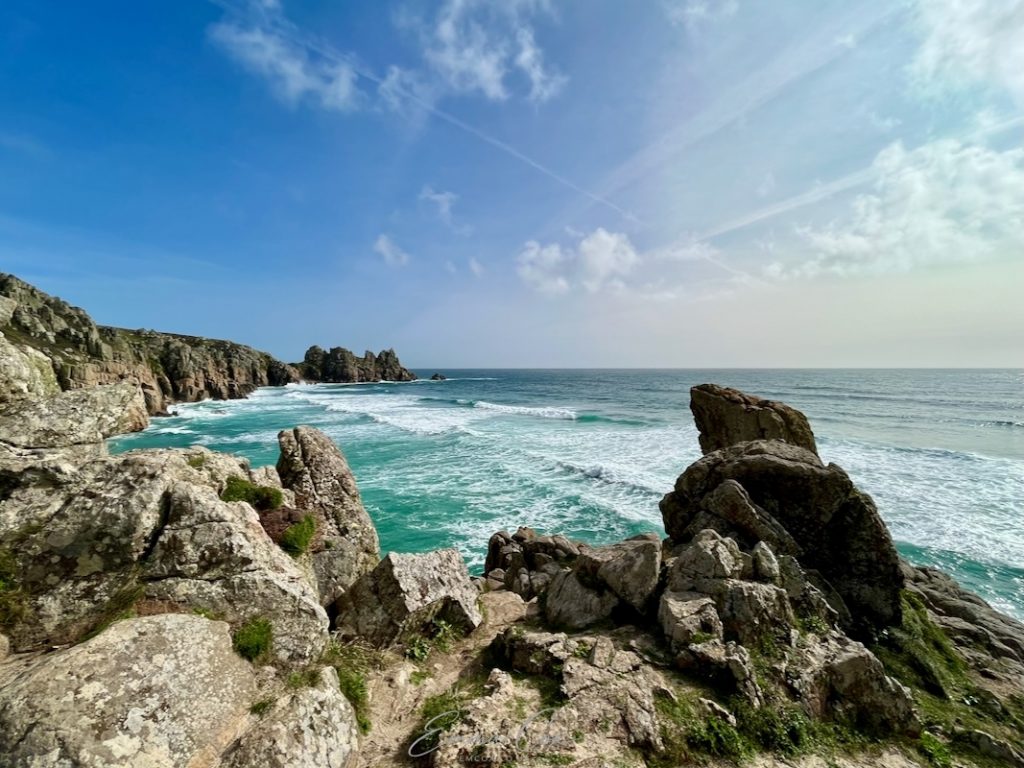
t is truly a unique theatre to visit. Nestled on the granite coast, at the mercy of the elements and with the backdrop of the endless sea. I keenly remember one visit to see Terry Prachett’s Wyrd Sisters and the Cornish stone and cliff worked perfectly in lieu of the fictitious Lancre.
I decided to enter. The problem was I’d never written a play before. I’d read a few plays, mostly Shakespeare, at school. To my luck, Scrivener had a template for a play, and I leapt straight in. Normally, my brain is primed to write a story which someone will read. I furnish them with the details to spark their imagination. They mentally give form to what I describe in words. In a play, I have the stage, props and players. Given the Minack’s uniqueness, the stage itself becomes a character, and the elements thrown at it can heighten the drama. The theatre’s origins came when Rowena helped with a local production of A Midsummer Night’s Dream, and she offered her cliff garden to the company for their next performance of The Tempest. These aspects are novel for me, but I had to bear in mind the stage and the backdrop. What can I write which will complement the stage?
Not only that, I have to think of the audience. When someone picks up a novel, they tend to read a chapter or two and then put it down and pick it up later. In a play, you have to capture their attention and keep them engaged. A difficult task in our addictive screen habits, as Rosamund Pike pointed out recently. There is also an opportunity to have a little fun and break the fourth wall with the audience. Approaching a character is something else quite different. My character notes are no longer directed at the reader, nor the audience, but the actor playing the part. No actor will play the character the same way, which brings another unique slant to the performance. Consider Nick Dear’s stage adaptation of Frankenstein, directed by Danny Boyle (if you were like me, you watched it online when the world was in lockdown), in which Jonny Lee Miller and Benedict Cumberbatch interchangeably played both Frankenstein and the Creature. All these different things to consider, and yet, I found myself thoroughly enjoying it. I’m not even bothered if I don’t win because the act of taking the plunge into doing something that exercises my creative brain in a different way is a huge benefit and bloody good fun.
The creative process
Every creative has their process and style. Some are more rigidly fixed to it than others. Some enjoy the comforts of familiarity, and to change it is a bit scary. Others wedge themselves in a niche, either of their own making or through their popularity. Like an actor who is repetitively typecast, an author may go with what works and sells instead of exploring the craft.
I was firmly in Team Pantser when I seriously took to creative writing. Sure, there was a vague direction of travel with a few points of interest scenes and a hazy idea of an ending, but the draft was an exploration of both plot and character. I enjoyed the freedom as, without a structured plot, the characters could breathe and, like the hero in the Fighting Fantasy books, choose their path. This, however, meant writing myself into multiple dead ends. The crux came when I pantsed a story which opened with a murder. Having a body without a clue on the murderer, the motive, and a list of alternative suspects with their own potential motives meant I needed to scoot over to Team Plotter. I learnt the skills which helped me complete the novel. Am I now firmly in Team Plotter? No. But I do have the experience from both camps that I can lean into depending on the story’s needs.
Similarly, my first forays into writing were epic fantasy, which demanded a high word count and detailed world building. However, I found space in the brevity of flash fiction, where no word is wasted. Haiku similarly revealed to me the delicate skill of turning a few words into a seed that blossoms in the reader’s imagination. One word can hint at a hundred more. The absence of words is a void the reader can fill. I still enjoy writing stupidly long fantasy stories, but I am conscious of points where less is often more.
Applying learning across the creative arts
Interestingly, this process of learning arcs across many creative outlets. Learning to edit film transferred into writing, emboldening me to be fearless in ‘killing my darlings’. Painting taught me to love my first written draft because it visually reminded me they both consist of many layers, which are tweaked until the finished piece is revealed.
If I have one piece of creative advice, do not be afraid to try. At worst, you’ll find it isn’t for you. But you will still have learnt something which you can apply elsewhere. At best, it will open a whole new path to explore. Further along the line, that path will splinter into other opportunities. Do not be afraid to explore all the paths which are open to you. Like the Choose Your Own Adventure books, keep replaying until you have explored everything you wish to explore.