Nature’s abstract paintings
Cornwall’s subterranean world may be dark, but it is colourful. The rich mineral deposits stain the walls in vibrant hues of red and blue. Nature’s abstract paintings. These deposits formed due to a catalyst between the protruding granite rock and the neighbouring sedimentary rock, and have been mined since the Bronze Age.
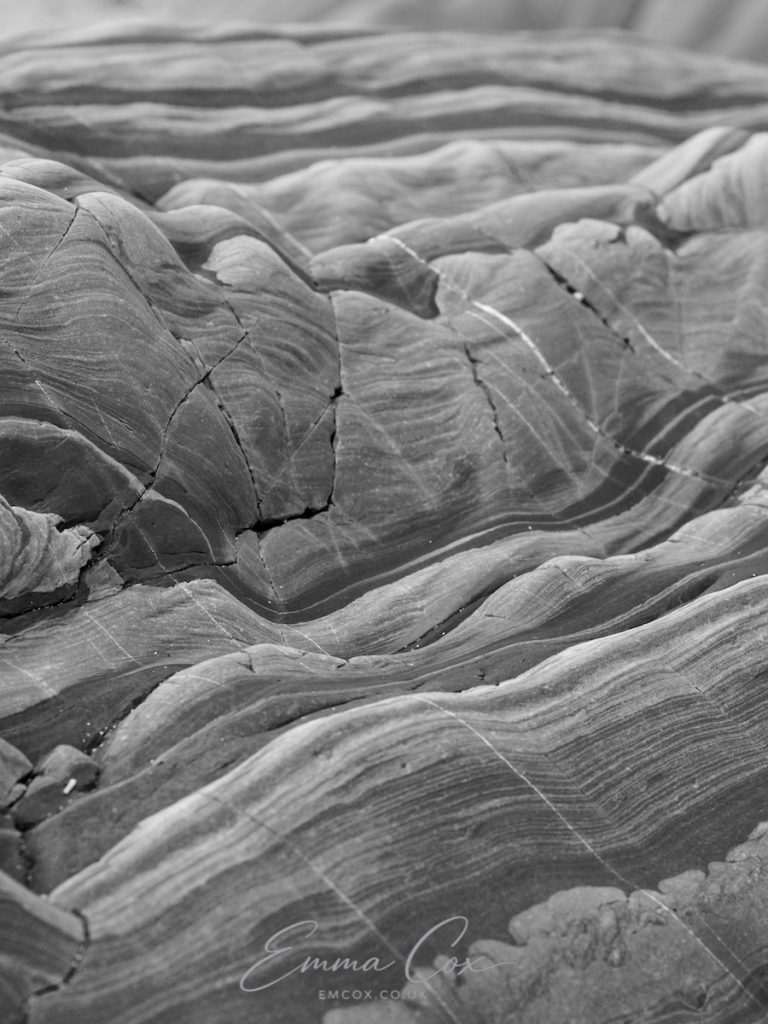
The natural stone art ripples like waves
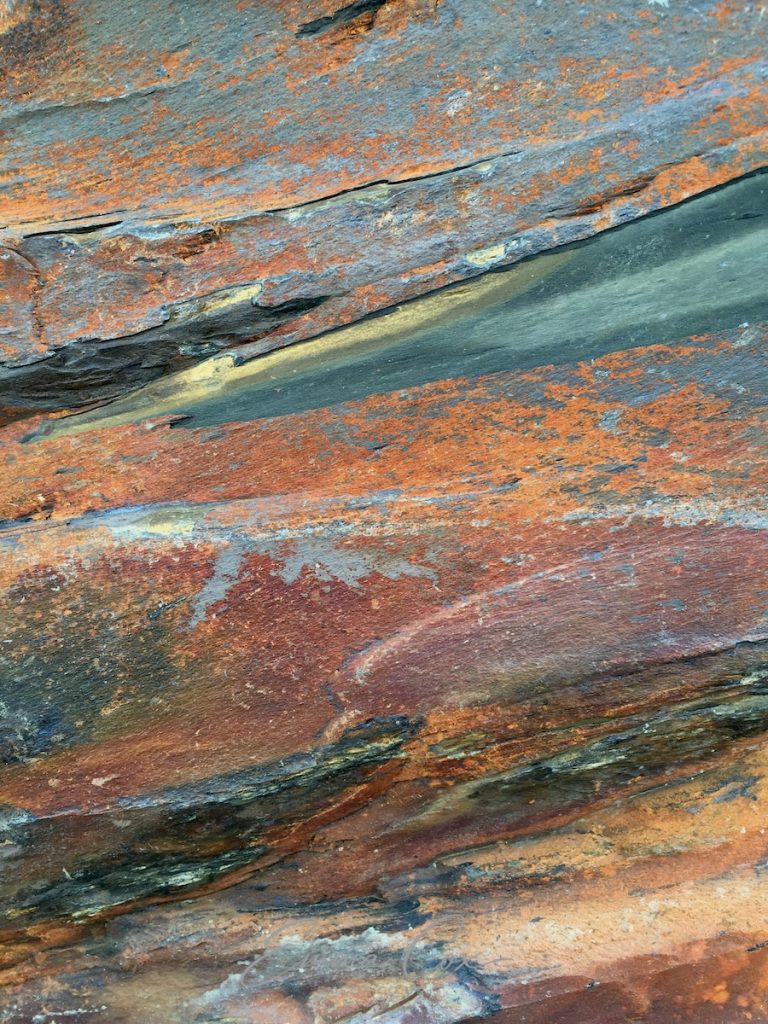
The colours in the rock look almost painted.
Christ in Cornwall?
While it is theorised that Cornwall is the Cassiterides (Tin Islands), first mentioned by Herodotus, there is evidence of Cornwall’s trade across the Mediterranean and Middle East. The tin and gold in the Nebra Sky Disc, created in 1800 BCE and found in Germany, came from Cornwall.
The Ding Dong mines are said to be the oldest, dating back to prehistoric times, although the earliest record of the Ding Dong mine is from the 18th century. The legend goes that Joseph of Arimathea visited the mines, accompanied by a young Jesus, to address the workers.
The Industrial Zenith
Any traces of ancient mining work have disappeared due to the industrial boom in mining spanning between the 16th and 18th centuries. Gunpowder replaced the grunt of the work produced by men with pickaxes in open-cast mines. Shaft mining brought another boon, producing vast warrens of tunnels deep below ground and beneath the sea, in their search for tin and copper, along with silver, arsenic, and zinc.
While the men worked below ground, the women worked above. They were the Bal Maidens (Bal is Cornish for mine) and tasked with processing the ore.
The industry reached its zenith in the 19th century as foreign imports became inexpensive. There is a saying that if you find a hole, you will also find a Cornishman. This was due to their mining expertise. As mining moved abroad, so too did the Cornish families in search of work, and took their knowledge and culture with them. Cousin Jack became a term for a Cornishman who had moved abroad.
The Cornish Alps
Botallack Mine and Wheal Alfred are two of the iconic cliffside engine houses which are visited and photographed today. Now, the mines are left to ruin. With no steam engines to pump the water, the shafts and tunnels are mostly flooded, and are only ventured into by the intrepid modern-day explorers. However, the China Clay mines at St Austell still operate, and there is a likelihood that the mining industry may experience another boom as human needs shift to different metals, such as lithium.
The End of an Era
The industry has left Cornwall’s landscape scarred and pockmarked, and internally riddled with holes, eroding the bedrock. Spoil heaps like those in St Austell have completely changed the topography. Their glowing white peaks have earned the nickname, the Cornish Alps, and noticeable manmade landmarks such as the White Pyramid. Look on old maps, and you will find villages and ancient monuments which no longer exist. Where footpaths once ran, there is now only thin air above a gaping quarry.
Yet these resources brought Cornwall wealth in its heyday, and they were innovators, such as Humphry Davy, John Harvey, and Richard Trevithick. Towns like Redruth, Camborne, Helston and St Austell grew from the mining industry. Today, the buildings the mineral wealth helped to build still stand, but poverty is rife, as it is throughout much of Cornwall. With mining and fishing dwindling, tourism is the key industry, which is a shame in some ways. Is there a way to return to traditional industries in a way that is sustainable and environmentally sound?
The Knockers
What was it like to work in those subterranean environments with only flame lanterns and candles for lighting? Such enclosed, dark places invoke different feelings in me. Sometimes, they are warm, womblike spaces of comfort. Other times, I can feel the weight of the stone above and around you. Fear tightens my skin, and I crave the open sky and fresh air.
It is no wonder that folktales crept into the mining industry. The knockers are a type of subterranean gnome-like creature who went out of their way to help the miners by knocking on the walls to hint at the location of a rich vein or to warn of an impending collapse. Although friendly, they had a habit of stealing the workers’ lunch or pinching their tools (I have a feeling this was probably done by an annoying coworker). They might blow out the candle perched on your hat, too. I’ve been deep in a cave when the lights are turned out. It is beyond dark. The Cornish pasty was the meal of choice while working in the mine, and the workers always left a few crumbs for the knockers to keep them pleased. Sometimes, the bucca is attributed to roles familiar to the Knockers. Additionally, they were also thought to be the spirits of Jewish miners from the 11th and 12th centuries. Those Cousin Jacks seeking employment across the world took their folklore with them, as can be seen in America with their Tommyknockers.
Coastal Caves and Other Subterranean Landscapes
There are other underground places to visit, such as the fogous, ancient manmade underground passageways, whose purpose is unknown.
There are natural caves along the stretch of Cornwall’s coastline. St Cuthbert’s Cave, at Holywell Bay, contains a natural spring that is said to have incredible healing properties. The minerals here have painted the cave in hues of red, green, blue and yellow. These mineral deposits have built up over time so the cave looks akin to melted candle wax and honeycombs.
Zawn Pyg, at Nanjizal beach, is a picturesque arch with a narrow sea cave, where the winter sunset illuminates the passage, and while Merlin’s Cave, beneath Tintangel, is steeped in Arthurian lore.
There are also some quirky caves to explore. In the 18th Century, John Stackhouse carved himself a cave on his favourite beach with a rock-caved bath to sit in. The botanist had lived for some time in Bath, and perhaps hoped the mineral and salt waters of Cornwall would have a similar restorative effect as the heated springs of Bath.
Inland, you can also find Carnglaze Caverns. Although it is a slate quarry, it has an added history of being a safe storage area in WWII (where the Navy kept important things, i.e. rum) and a concert hall.
Exploring the Dark Places
There are times when I have found old adits in the cliff face, and I’m drawn to slip inside and see how far I can wander. A neighbour took me to a friend’s piece of land near St Austell, which had a few openings to old mines. I went down on a rope and found old tunnels, but couldn’t venture too far as the water table was too high. But it is quite a place to walk and wonder about the people who carved these passageways all those years ago.
Heading Back to the Surface
There is a light ahead. Sunlight beams in. If you wish, stay hidden and explore the dark passageways and the rock; you’re welcome to stay. Or head towards the daylight and back onto open moorland and fresh air.
Links: