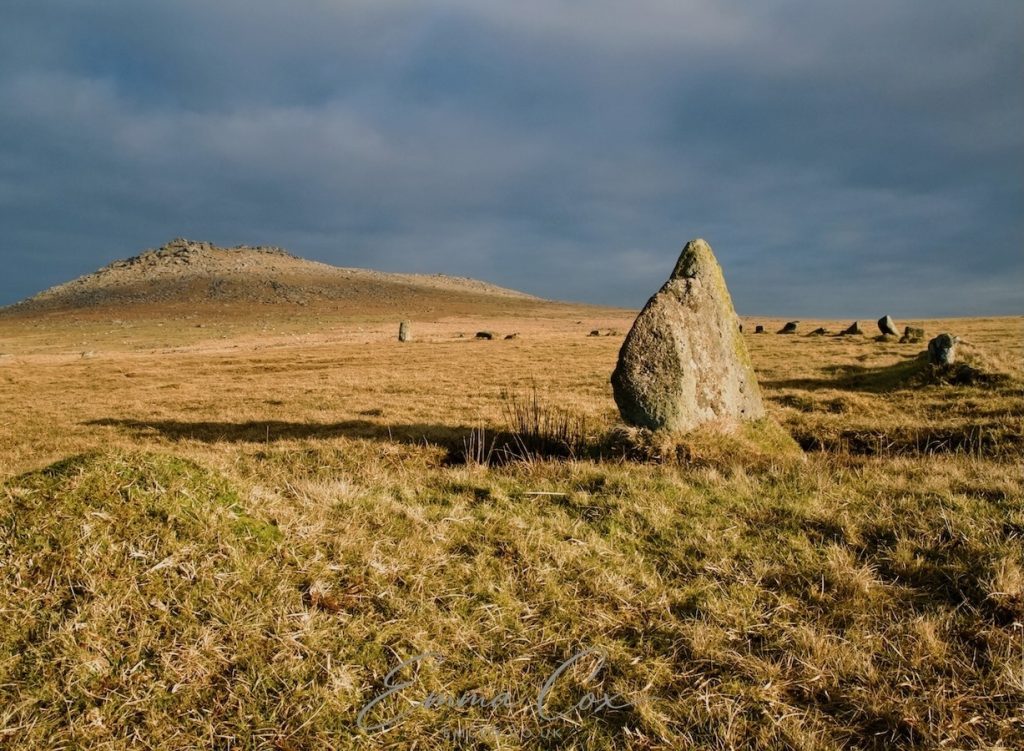
Step onto the Cornish Moor
It is the height of summer. The expansive sky is a brilliant blue and the moors before me is a textured brush of yellows and greens. Dry stone walls delineate the odd patch of pasture, but for the most part, the space is open and free. Swallows somersault through the air, and the heady scent of gorse fills it.
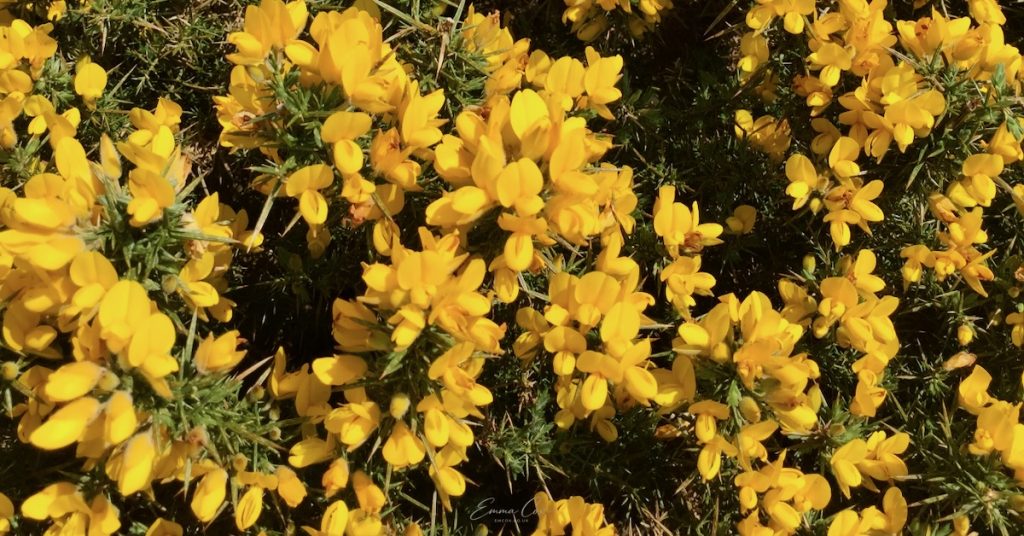
These bright yellow flowers have a coconut and pineapple scent. Should the moor make me think of Piña Coladas and getting caught in the rain? This is the moor, and rain is normally in the forecast. Despite blue skies, I might get caught in a shower or two before this walk ends.
I raise my camera and photograph the gorse. It will not capture the scent, but the image invokes a sensory memory.
The accent is long but gentle. An easy stride to warm the legs before the terrain gets steeper. The gorse in the sheltered low levels grows sparser as I climb. There is little ahead save for the odd lone, crooked-backed blackthorn, bent, but not to be beaten by the harsh Atlantic winds.
Perhaps I try to see the moor in its good light? I find it persistent and freeing. But each moor and tor has its own character. The summit of Rough Tor is one of my favourite places, yet Carn Kenidjack unsettles me for reasons I can’t quite explain. I was photographing Carn Kenijack once, after sunset. I recall the breeze whipping around me, through the grass and over stone as I walked home. I could not shake off the feeling that creatures, unseen and child-sized, were running alongside me. I felt like a spooked sheep being rounded up by a border collie and driven off the moor. Darkness was falling, and I was not meant to be there. It is no wonder this particular site has a folk history of Devil’s and fairies.
The granite summit draws nearer. I pause, taking in the view. I am not the first writer to anthropomorphise the moor. Often, it is depicted as a stern, wild place, and very much a character in its own right. Catherine and Heathcliff in Brontë’s Wuthering Heights desired the Yorkshire moors instead of Heaven. Egdon Heath in Hardy’s Return of the Native is a barren, isolated land which echoes the plight of the story’s characters: if you want to thrive, move away! In Jamaica Inn, Du Maurier depicted Bodmin Moor as a stark, lawless place.
I follow the sheep track, spying them and their white fleeces further up amongst the scree. Yes, the moor is bleak. Yet in its desolation, there is something quite humbling. These open spaces make me feel wonderfully small and insignificant. There is a sense of inner peace, and sadness, too, because I can’t help but think of the ancient temperate woodlands which were once abundant in Cornwall. The moors are natural, yet they are as human-made as the field systems in the fertile land below.
The Granite Spine of Cornwall’s Tors
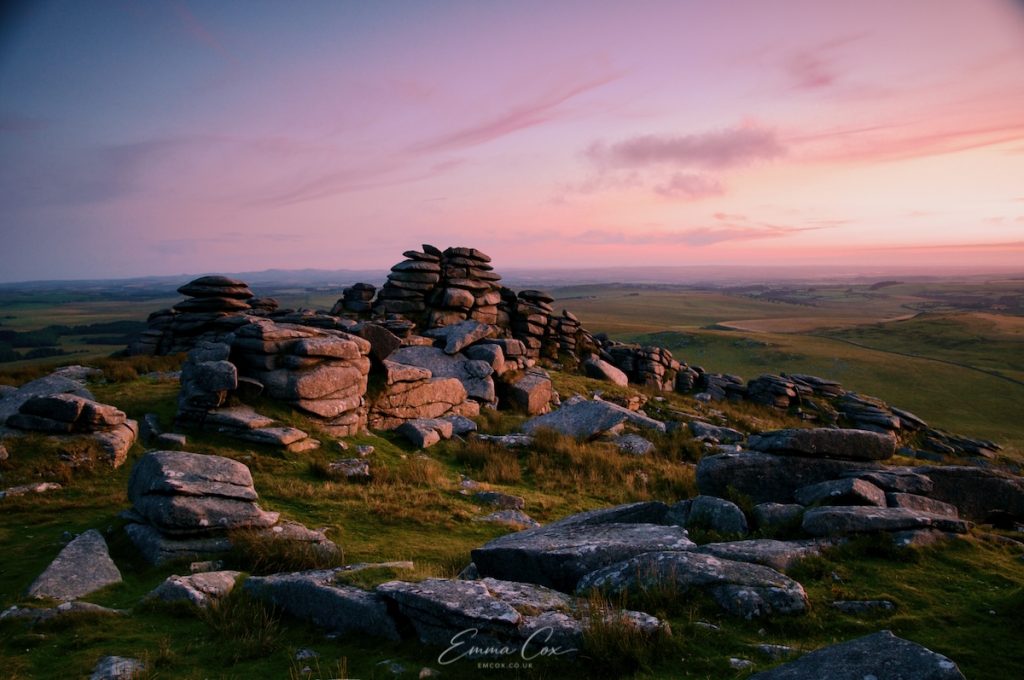
I near the summit. The grass is littered with granite, which has been slowly shedding from the outcrops above over countless millennia. In Cornwall, the granite tors run east to west like a giant’s spine protruding from the earth before slipping beneath the waves and surfacing again at the Isles of Scilly.
This granite intrusion into the surrounding sedimentary rock is the reason why Cornwall is rich in minerals and metals, a resource mined since the Bronze Age. My eyes are drawn to these tors. Stone stacked upon stone. You can almost believe the folktales which say they were moved by giants. I can also understand why such impossible-looking structures drew our ancestors to settle and build here.
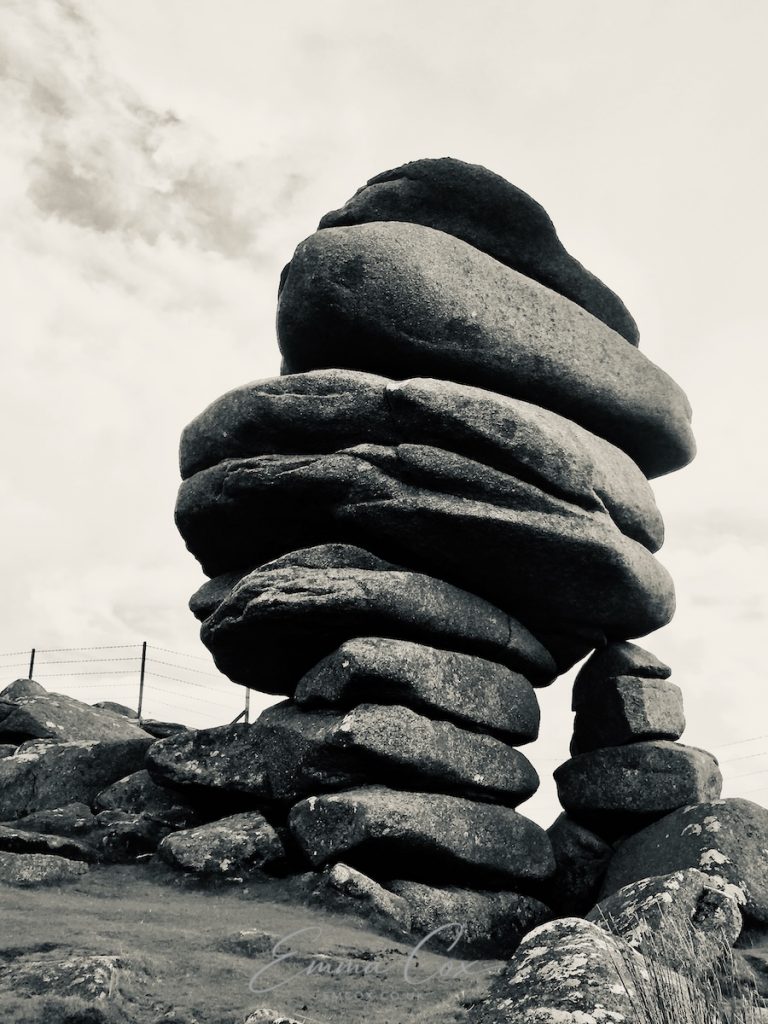
A natural granite rock stack.
The highest of these granite intrusions is Brown Willy on Bodmin Moor. A name thought to derive from the Cornish Bronn Ewhella, meaning ‘highest hill’ or Bronn Wennili, the more evocative, the ‘hill of swallows’.
The weathered tors make interesting shapes. Like the clouds now building overhead, I can see the stony profiles of men and beasts petrified in the rock. Looking away from the expansive vista, I can hone in on blooms of lichen spread across the stone like a cartographer’s map, and pass my hand across a natural basin carved in the granite. They say they caught the blood from druidic sacrifices. Today, it is filled with rainwater.
This landscape isn’t confined to the high ground. If you were to follow the granite westwards, you would find the lower level moors such as Penwith (Pennwydh, ‘the end headland’) and Goonhilly Downs (goon helghi, ‘the hunting moor’). Here, the moor’s character shifts. There is something invigorating about standing on the peninsula with the moor beneath your feet and nothing but the sea on three sides and the horizon ahead.
How People Shaped the Moor
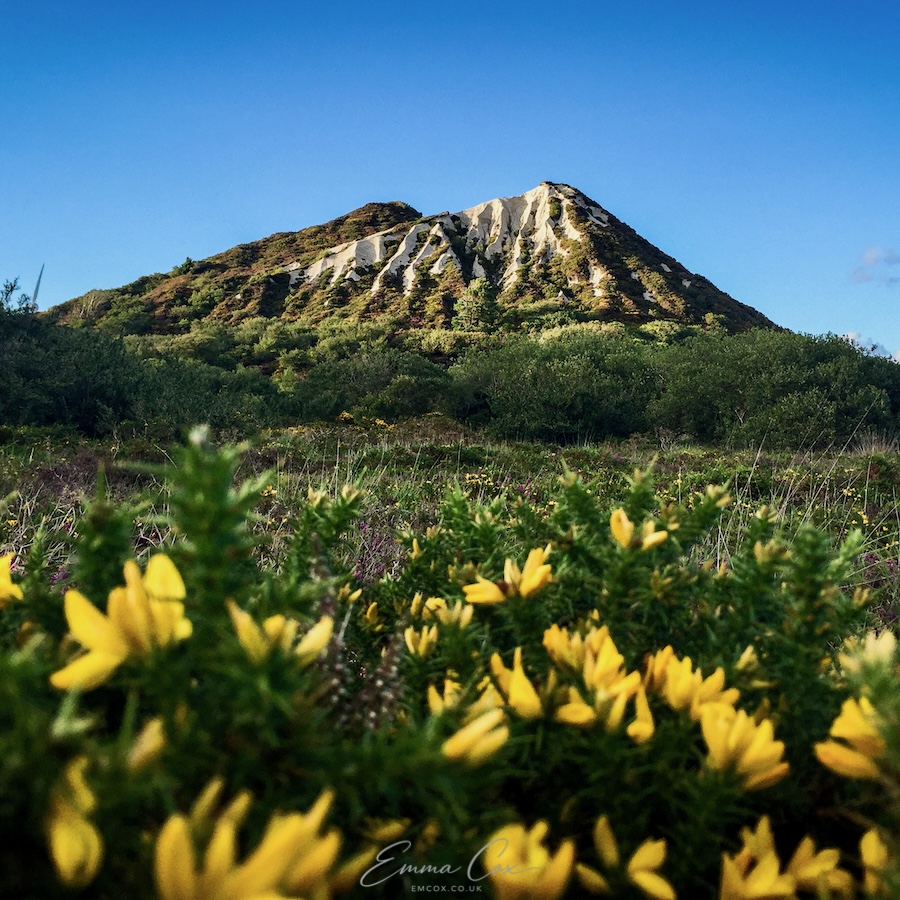
The path peaks and slopes downwards into a sheltered valley, passing rings of stones and pockmarked ground which undulates beneath my feet. A clay quarry blanches the distant landscape so it is more reminiscent of the lunar surface. Pools made on this pure white ground reflect the sky in a shade of blue that looks almost unnatural.
A clump of squat, twisted oaks dressed in a heavy mantle of moss and lichen grows between the granite boulders. The moor was not always bare. These are some of the remaining fragments of the ancient temperate forests. Mesolithic hunter-gatherers would have sought resources from these woods. In Neolithic times, people became settlers, and forests were cleared to create farmland.
Settlements appeared, followed by cemeteries for their dead. I pause at the stone circle, meandering around the stones before entering the centre. Does it feel different within the stones? I take out my sketchbook and draw the one that draws me in. What was this site’s true purpose? We can only speculate through the remains and our present scientific capabilities.
Bronze replaced stone, and iron replaced bronze.
Industry followed and flourished. The Cornish traded its reliable and plentiful tin resources with the known world. The moors opened further. It offered pasture, quarried stone for buildings and field boundaries, and rich seams of ore, clay and minerals.
A derelict engine house, with its twin windows and yawning doorway, stares at me like a human face. The industry reached its height during the Industrial Revolution and declined when imports became cheaper. Engine houses fell silent and slipped into ruin.
Stories Rooted into Rock
The rain arrives, sweeping across the moor and robbing the last of the sunlight. It falls in sheets with an urgent hiss, and the wind strengthens. The clouds hang low, hiding the tor’s peak and makes my world feel smaller.
People made a living on the moorlands, but it is the stories of its smugglers, thieves and murderers which stand the test of time.
The sunlight returns, casting my silhouette onto the mist in front of me. My own Brocken Spectre. Many say the Cornish moors are places where fairies led people astray, and Arthurian myths bind their roots to bedrock. Where seemingly improbable geology is the work of the giants, saints and devils. It harbours legends like the Beast of Bodmin Moor. Ancient lithic monuments are claimed to be people turned to stone, and the granite peaks are the meeting places where the creatures from Hell come to wrestle.
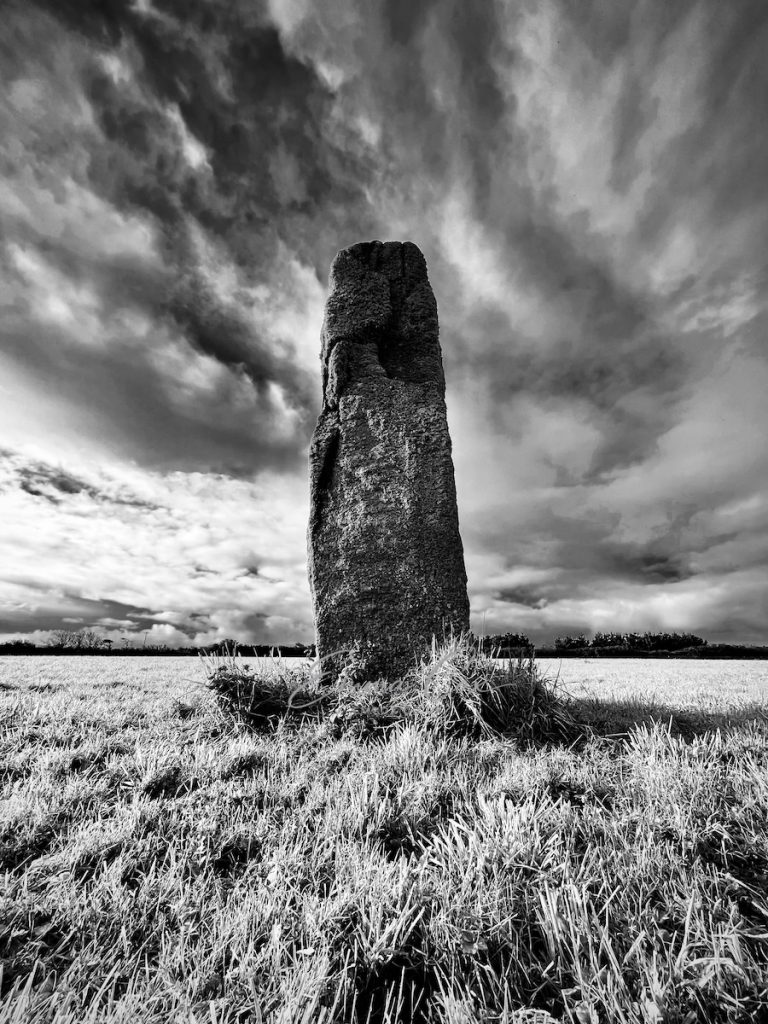
A man petrified for playing on the sabbath?
To this day, the Cornish moors continue to attract artists and storytellers, myself included. We find inspiration in the landscape and create new tales or build on those which came before.
I recall an evening atop Rough Tor, photographing the full moon rising. Walking back in the dark, the grazing ponies raised their heads in acknowledgement, their eyes shining eerily in the torchlight. As the ground sloped towards the stream, near the memorial where Charlotte Dymond was murdered, the air grew colder.
I knew it was a change in atmosphere. Yet the physical reaction from the drop in temperature ignited the story of Charlotte’s ghost in my mind. But that is the part which interests me. It’s how a place can shape feeling, and how feeling gives rise to art and story.
Creative Inspiration Drawn from the Moor
This solitary walk in nature, especially in such a high, open space, is a perfect ego-dampener. It quietens my commercial need to create, and shifts it to an open mind ready for inspiration to fill it. I raise my camera, taking in the view in all its clarity. This is how I connect to the moor: by creatively engaging with it. I take more photographs with the intention of using them as study materials for a painting. How can I invoke the light and textures through paint and brushstroke?
Pausing on a rock, I write a few lines. Perhaps some that describe the sensory details I will later forget. Or words which spring to mind and tumble wherever they feel the need to go. Another pathway forged, but through words.
Leaving the Moor
The path diverges. You can remain on the high ground with an open sky and explore further, or take the path gently sloping downhill, where the bursting springs turn to streams and follow into shaded woodland.
Links: