Standing stones are easy to anthropomorphise. Each has its own sense of character depending on its shape, size, and composition. Consider, too, its surroundings (and the weather). Today, the skies are grey, but the visibility is reasonable compared to my last venture across Goonhilly Downs in the mist and rain.
It is February, and the colour sparing. Here on the heath, it’s an artist’s palette of brown, muted green, straw-yellow, and rusty orange. The only shock of colour comes from the yellow gorse flowers, which appear all the brighter and more vibrant against a moorland still groggy from winter’s slumber.
The Standing Stone
On such a grey day in early spring, the Dry Tree menhir comes across as a character who’s getting tired of its feet sitting in the boggy peat, but welcomes a morning without rain. In a few days, it will be March, and most of Cornwall has not seen a day without rain.
I fear I am projecting my feelings onto the inanimate stone. The fleeting hours when the rain clouds part and the sun shines have become a tonic. The sun hides behind the clouds today, but I feel its warmth returning as the days lengthen.
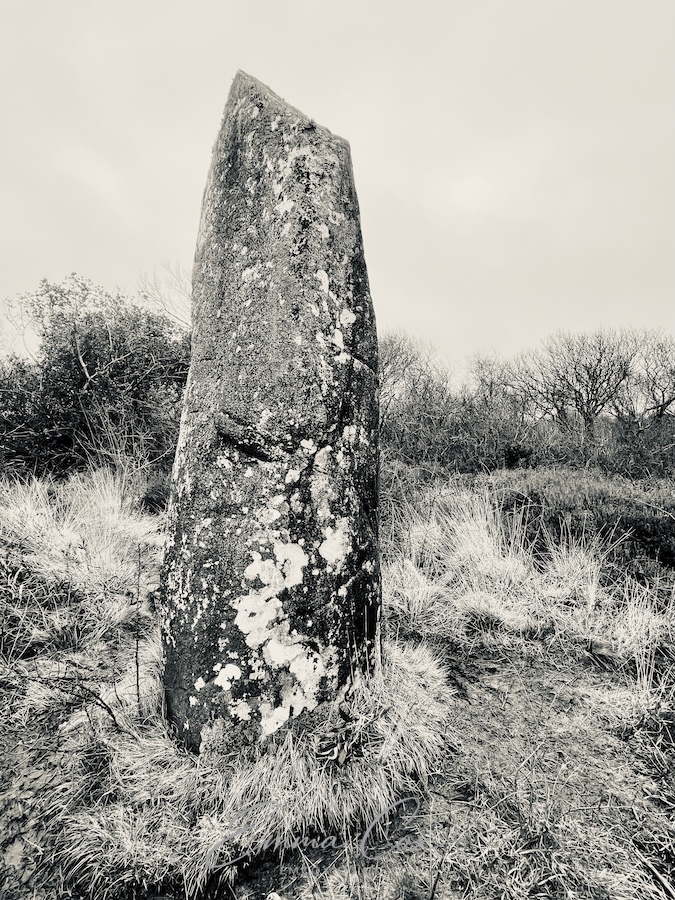
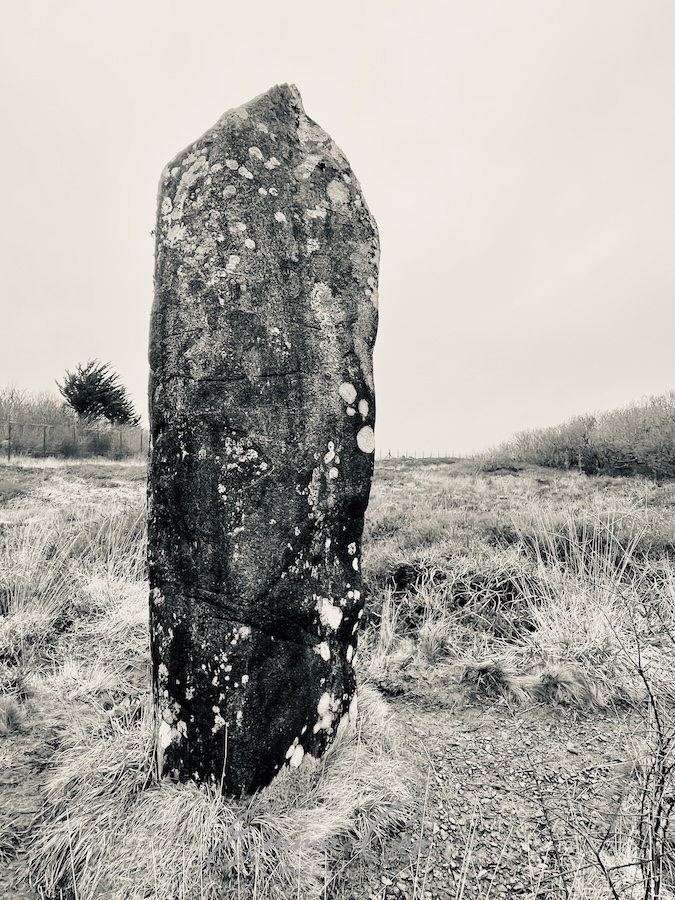
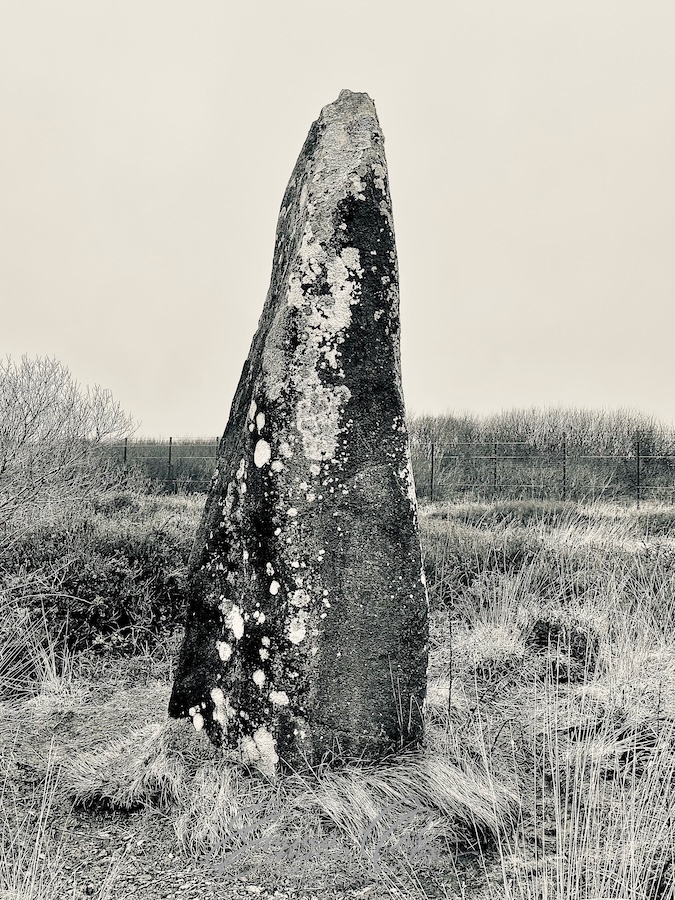
The Dry Tree menhir is somewhat of a wounded soldier. Opportunist treasure hunters caused its collapse, and soldiers stationed nearby in World War I decapitated three feet from the top to use in the building of a road.
It stands proud once more (albeit a little shorter), thanks to the Porthhoustock quarrymen in 1928, under the direction of Col. Serocold and Mr Maynard, the curator of Ipswich Museum, and funded by the late Col. Sir Courtney Vyvyan, Bart, of Trelowarren. The base below ground is apparently now set in concrete, so it won’t be going anywhere soon.
Weighing around fifteen tons, this once 4m stone now stands to a height of 3.2m. During its resetting, traces of charcoal were found, suggesting a cremated burial or offering, and several stones indicate a potential burial cist. Neighbouring the menhir are three Bronze Age round barrows. However, the menhir isn’t entirely local.
A stone of significance?
The Dry Tree menhir is an igneous rock called gabbro, which is low in silica and rich in iron, magnesium, and calcium. This is significant because the nearest site of gabbro rock is three miles away at St. Keverne. Therefore, the rock was carefully selected and transported to this location.
Considering the company the Dry Tree menhir keeps, it is easy to speculate on the what and why. Why was this site significant? What came first, the barrows or the menhir? What did this specific type of stone represent to these people? Was it spiritually significant? Was it a sighting stone to aid in navigation? Or a border marker? On the subject of borders, it is interesting to note the borders of six parishes meet at this point: Grade Ruan, Cury, St Martin in Meneage, Mawgan in Meneage, St Keverne – Coverack, and Mullion.
The lack of hard evidence makes such sights even more beguiling to me. As a storyteller, it is easy to see why folklore grew around these lithic places, which were deliberately made, but as to the how and why (and sometimes who), things become murkier. To be human is to both study the world around us and to create meaning. We anthropomorphise, as I have already done with the Dry Tree menhir, to bridge a connection and understanding of our place on earth.
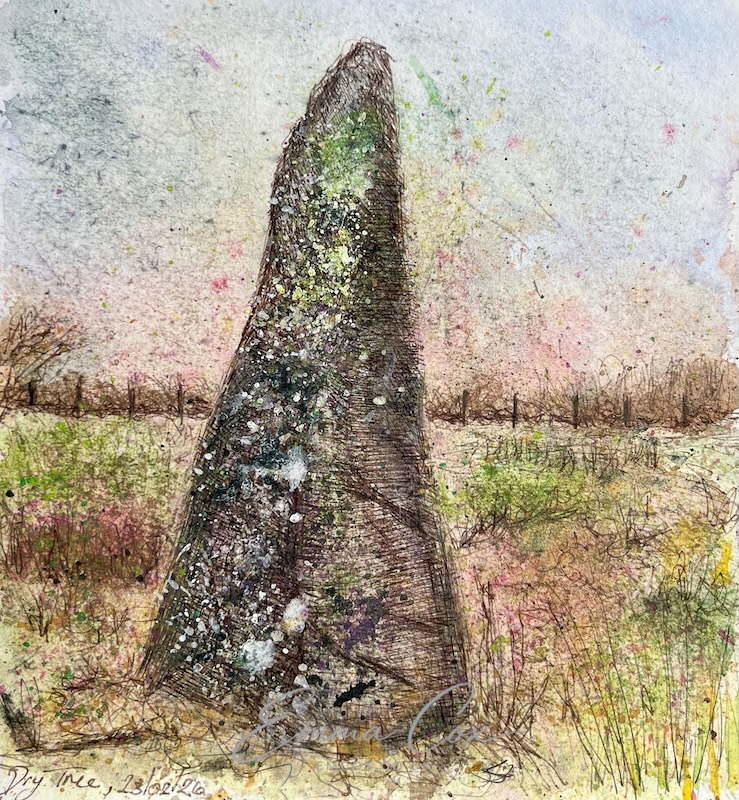
My pen and watercolour sketch of the standing stone
The origin of the Dry Tree name
The menhir’s name intrigues me. The etymology of place names is especially interesting because it can reveal so much. After some digging in the newspaper archives, I discovered the name originates from a much more recent timber pole, which once stood nearby on this 110m summit and acted as a directional landmark. In the 19th century, this spot was a regular meeting point for hunts, which were popular enough to be advertised and reported in the county newspapers. It is unsurprising, as the name Goonhilly comes from the Cornish goon (moor) and helghi (to hunt).
The historic significance of solitary trees
The Dry Tree is also a name given to a legendary solitary tree in the Persian desert, which was first recorded by Marco Polo and supposedly marks the spot where the battle between Alexander the Great and Darius took place. A legend Tolkien adapted in The Lord of the Rings in the Tree of Gondor. Goonhilly’s few trees are mainly willow, a tree which thrives in boggy soil, and a few wind-bent thorns. An erected piece of straight timber in such a landscape would certainly gain such a name.
Other Dry Trees on the Lizard
In fact, it’s not the only Dry Tree on the Lizard. In nearby Cury, there was a solitary large ash named the Cury Great Tree, which witnessed a large brawl between men of neighbouring parishes arguing over smuggled booty. But after the tree died, it went by the name of the Cury Dry Tree. A newspaper article reiterates the story of Cudden Hugh, a chronic ne’er-do-well, whose friends shoved him on a vessel heading to America in the hope he’d improve himself. However, Cudden grew bored and homesick. He took a boat back to England and told the captain to steer for the Dry Tree. Sir J Langdon Bonython also tells a similar tale in another newspaper article a few years later.
The newspapers also suggests the Dry Tree had a second use as a hanging post.
Murder on Goonhilly Downs
In the early 19th century, Goonhilly Downs was an even more desolate and dreary place. Hundreds of acres and not a single dwelling upon it. That was until a father and his two sons built a hovel there and occupied it. Neither man worked nor had any visible means of sustenance. Yet perhaps this can be explained by the disappearance of some pedlars who regularly walked the route, who were never seen or heard of again.
Night had fallen, and a rider cantered along the road. Behind, he hears a pony trap and the murmur of voices from its two occupants. Did the rider see his murderer rising from the heath before firing their gun at point-blank range? Those in the trap fled to Helston and found assistance in the shape of an officer who’d fought at Waterloo. Armed to the teeth, the officer rode to the lone house on Goonhilly Downs to discover the father and two sons had already fled. Two escaped and supposedly fled abroad. The third was captured and hanged on the Dry Tree.
This appears to be an embellished version of the events which took place in August 1820, which I examine fully in the Goonhilly Murder blog post.
The Dry Tree name endures
It’s unclear when the Dry Tree pole disappeared. But its necessity as a landmark likely diminished when a radar station was built on the site in the Second World War and was named RAF Dry Tree. The Dry Tree pole has vanished, and the RAF buildings are little more than derelict ruins and hidden foundations amongst the heath. However, the ancient standing stone is still there and continues to carry the name. Some may argue that this standing stone does have a trunk-like appearance. Did the menhir give the timber post its name, or was it the other way round? More to speculate. More stories to make from the decaying fragments of the past.
Still looking at the stars
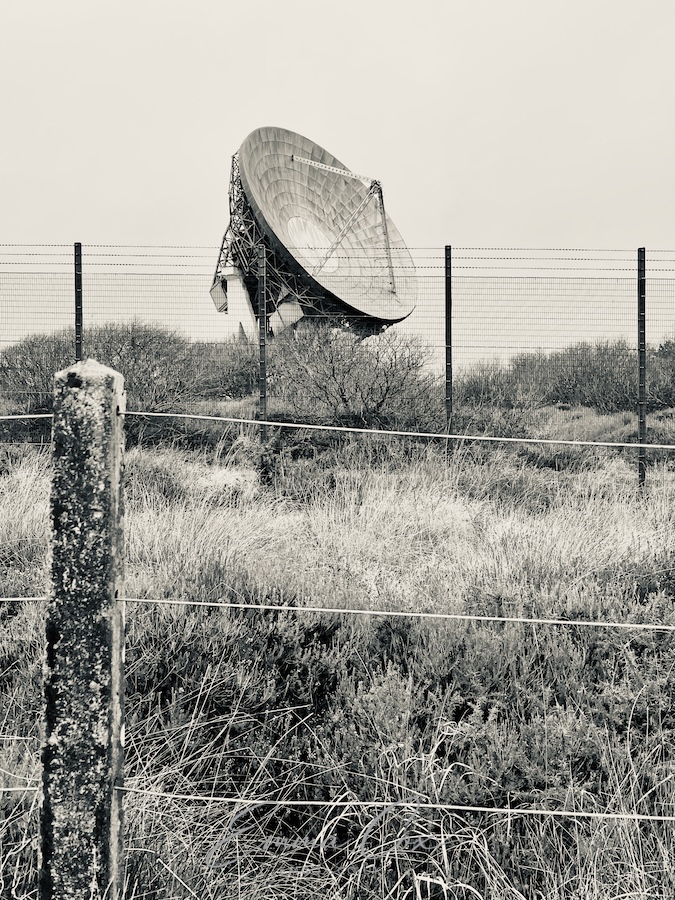
Today, the standing stone’s presence in the landscape is dwarfed by the dishes at Goonhilly Satellite Earth Station, which are named after characters from Arthurian legends. The first dish erected was named Arthur, while the largest is named after Merlin. Considering many lithic monuments are aligned to the sun and moon, it seems apt that it also became a spot for a modern monument that looked to the skies.
Parking is at the Goonhilly Downs National Nature Reserve Walk Car Park just off the B3293.
References:
- The Romance of the Stones: Cornwall’s Pagan Past – Robin Payne & Rosemarie Lewsey
- Goonhilly: The Hunting Downs – West Briton and Cornwall Advertiser 09/04/1874
- The Dry Tree – St Austell Gazette 02/02/1949
- The Goonhilly Murder – The Cornish Post and Mining News 13/08/1896
- Antiquities of the Helston District (A.S. Oats) – West Briton and Cornwall Advertiser 20/05/1948
- In Holiday Land: The Polurrian Hotel, Mullion (Herbert Thomas) – The Cornish Telegraph 11/05/1911
- A Distinguished Cornish Visitor – The Commercial, Shipping & General Advertiser 10/05/1907
- https://www.cornwall.gov.uk/environment/trees-hedges-and-woodlands/ancient-trees/
Pingback: The Goonhilly Murder (1820) – Emma Cox